Fire Point FP-1 Drone Specs, Range and Cost
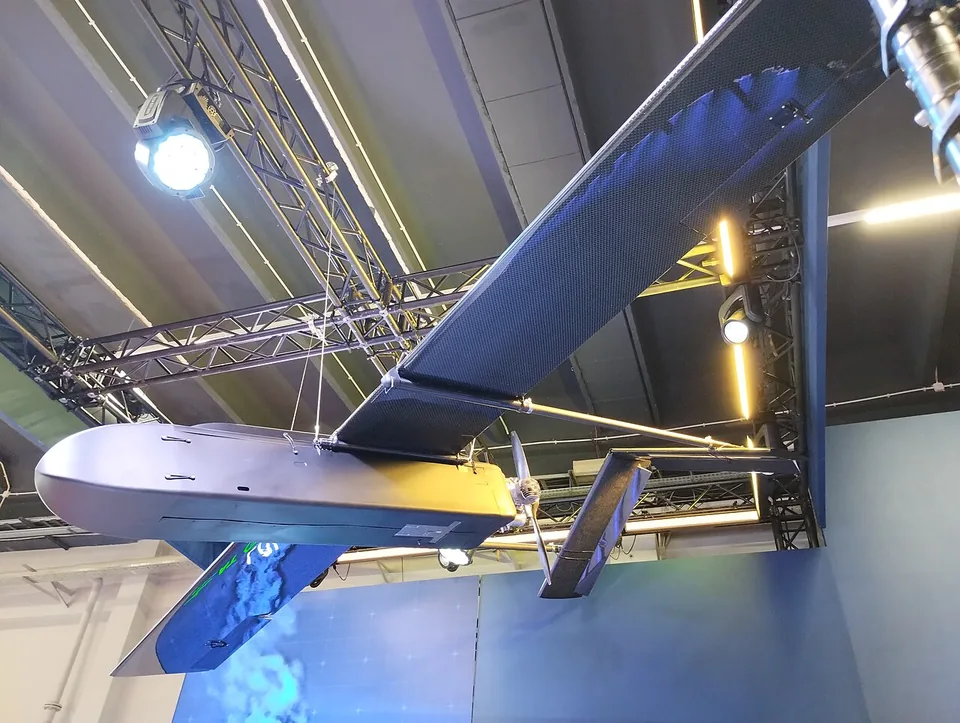
The FP-1 drone is a long-range one-way attack drone built by Ukrainian company Fire Point. The Associated Press and The War Zone reported in August 2025 that it costs about $55,000 per unit and flies up to 1,600 km with a 60 kg warhead.
Later figures differ by source and version: ArmyInform reported 1,000 km with a 105 kg warhead in March 2026, and Fire Point told Defense News the rebuilt FP-1 flies 1,677 miles. No source used here publishes the drone's speed.
FP-1 at a glance
| Manufacturer | Fire Point (Ukraine) |
|---|---|
| Origin | Ukraine |
| Category | One-way attack UAV |
| Role | Long-range one-way attack drone built by Ukrainian company Fire Point and used for strikes deep inside Russian territory, according to the Associated Press and UNITED24 Media. |
| Aliases | Fire Point FP-1 · FP-1 drone |
| Evidence status | Confirmed system use |
What the public record establishes
Every account of specific FP-1 strikes comes from Fire Point, Ukrainian officials or outlets quoting them. UNITED24 Media links FP-1 strikes to refineries in Saratov, Novokuibyshevsk and Volgograd. Ukraine's General Staff said drones hit the Omsk refinery on 6 July 2026, about 2,700 km from Ukrainian-held territory, according to Reuters via The Star.
Fire Point said its upgraded FP-1s carried out that strike and a second Omsk strike on 8 October 2026. Omsk governor Vitaly Khotsenko said air defenses destroyed most of the drones in July, and he did not say whether the refinery was damaged in October.
Defense News attributes the 20 June 2026 Tyumen refinery strike to the FP-2, while Zelensky credited upgraded FP drones.
The distinction between platform identity and event attribution matters. A manufacturer page can establish what a drone is; an official military release, UN report, or conflict-monitoring source is needed to establish where it appears in a war. Where those records do not align, this page keeps the uncertainty visible.
This is a non-operational reference page. It explains the manufacturer, platform family, and public conflict record without providing instructions for building, targeting, deploying, or modifying a weapon system.
FP-1 at a Glance: Reported Specs and Cost
The FP-1 drone is a Ukrainian long-range one-way attack drone made by Fire Point, and its published figures come from Fire Point, Ukrainian officials and news outlets. No official specification sheet appears in the sources used here.
The earliest figures date from August 2025, when the Associated Press (AP) and The War Zone both reported a range of up to 1,600 km and a 60 kg (132 lb) warhead.
In March 2026, ArmyInform reported a 105 kg warhead at a range of 1,000 km. Euromaidan Press, on a page labelled advertorial, says the heavier warhead came with a spring 2026 second generation that moved fuel into the wings.
No source used here publishes the FP-1's cruise or top speed, its wingspan, its length or its engine model. UNITED24 Media describes a carbon fiber airframe shared with the FP-2, and no other source used here confirms the material.
Navigation has changed several times, according to the sources. AP says Fire Point first used navigation equipment from a major Western firm, Russian electronic warfare disrupted it, and Fire Point then wrote its own software. ArmyInform says developers changed navigation systems seven times during the war and are testing terrain image matching that works without the Global Positioning System (GPS).
| Parameter | Reported figure | Source |
|---|---|---|
| Range | Up to 1,600 km (994 miles) | AP and The War Zone, August 2025 |
| Range | 1,000 km (with 105 kg warhead) | ArmyInform, March 2026; Euromaidan Press gives 1,000 km for the first generation |
| Range | 1,025 miles, rising to 1,677 miles for the rebuilt FP-1 | Fire Point via Defense News, June 2026 |
| Range | 3,000 km for upgraded FP drones | Zelensky, quoted by Euromaidan Press, June 2026 |
| Warhead | 60 kg (132 lb) | AP and The War Zone, 2025; Euromaidan Press for the first generation |
| Warhead | 105 kg | ArmyInform, March 2026; Euromaidan Press for the second generation |
| Speed | Not published | No source used here |
| Wingspan and length | Not published | No source used here |
| Engine | Not published | No source used here |
| Airframe | Carbon fiber, shared with the FP-2 | UNITED24 Media only |
| Guidance | Inertial and satellite navigation (first generation); terrain matching added | Euromaidan Press; ArmyInform reports map-matching tests |
| Takeoff | No airfield needed | AP |
| Unit cost | About $55,000 | AP, The War Zone, and Iryna Terekh via Kyiv Independent |
| Unit cost | As little as $50,000 | Euromaidan Press (advertorial) |
| Production rate | About 100 per day (2025); about 200 per day (2026) | AP; Denys Shtilerman via ArmyInform. Terekh told Kyiv Independent 100 per day was maximum capacity |
How Much Does an FP-1 Drone Cost?
An FP-1 drone costs about $55,000 per unit, according to AP, The War Zone citing Fire Point, and Fire Point's Iryna Terekh speaking to the Kyiv Independent in August 2025. Euromaidan Press, on an advertorial page from June 2026, prices the FP-1 at "as little as $50,000" per drone. No source used here explains the $5,000 gap or says which FP-1 version each price covers.
None of the reports says what the $55,000 figure includes. Ukraine's Defense Ministry has published no FP-1 unit price for 2025 or 2026 in the sources used here, so every price figure traces back to Fire Point or to a single outlet.
The Kyiv Independent reported, citing documents and sources, that Fire Point sold FP-1 drones worth Hr 13.2 billion (about $320 million) to the government in 2024. That was just under a third of the Hr 43 billion (about $1.04 billion) the Defense Ministry spent on drones that year.
Chief technology officer Iryna Terekh told the Kyiv Independent that Fire Point sold about 2,000 long-range drones in 2024 at roughly $55,000 each.
Multiplying Terekh's two figures gives 2,000 × $55,000 = $110 million, which is lower than the roughly $320 million sales figure the Kyiv Independent reported from documents. The sources used here do not reconcile the two numbers. Separately, the Kyiv Independent reported that Ukraine's National Anti-Corruption Bureau (NABU) is investigating whether Fire Point inflated component values, delivery counts or both. Fire Point denied the accusations, and no charges had been brought.
What Is the Range of the FP-1 Drone?
The FP-1 drone has no single published range: reported figures run from 1,000 km to 3,000 km, depending on the source and the date. AP and The War Zone, the latter citing Fire Point, reported in August 2025 that the maximum was about 1,600 km (994 miles). ArmyInform reported 1,000 km in March 2026, paired with the 105 kg warhead.
In June 2026, Fire Point told Defense News that its rebuilt FP-1 flies 1,677 miles, up from 1,025 miles. Converted at 1.609 km per mile, that is about 2,700 km, up from about 1,650 km. The same month, Zelensky said "the new, upgraded FP drones" could reach targets at 3,000 km, as quoted by Euromaidan Press.
Euromaidan's author speculates, without confirmation, that the 3,000 km version may carry a smaller warhead. No source used here gives a version-by-version table pairing each range with a warhead weight, so the 3,000 km figure cannot be matched to a payload. Strike reports offer a separate reference point: Ukraine's General Staff put the July 2026 Omsk strike at about 2,700 km from Ukrainian-held territory.
The design started with a shorter target. Chief designer Denys Shtilerman told UNITED24 Media that the original FP-1 goal was a 50 kg payload at about 700 km, with design work beginning in late 2022.
Who Makes the FP-1 Drone?
The FP-1 drone is made by Fire Point, a company registered in Ukraine. Co-owner Denys Shtilerman told a parliamentary investigative commission that Fire Point is valued at over $2.5 billion, according to LIGA.net. Defense News, citing The New York Times, says Fire Point was a film and television casting agency before the 2022 invasion. Fire Point was named Centrocast until February 2023, the Kyiv Independent reported.
AP says the founders are close friends with backgrounds in construction, game design and architecture and no defense experience. UNITED24 Media names Terekh as chief executive and chief technology officer, Shtilerman as chief designer and Yehor Skalyha as general director. Defense News says Mike Pompeo joined the advisory board in November. Terekh told the Kyiv Independent that staff grew from 18 in 2023 to about 2,200.
Public corporate documents cited by the Kyiv Independent show revenue rising from $4 million in 2023 to over $100 million in 2024.
Sources disagree on the legal owner: the Kyiv Independent named Skalyha in August 2025, then called Shtilerman (spelled Shtilierman in that explainer) the de jure owner in its May 2026 explainer. No source used here mentions a stock listing. The reporting describes Fire Point as held by named co-founders, with stake talks held privately.
According to the same explainer, Shtilerman has tied a space-launch program to a $750 million stake purchase by Edge Group, based in the United Arab Emirates (UAE). Ukrainian anti-monopoly regulators are reportedly examining that stake purchase.
The Kyiv Independent reported in August 2025, citing five sources, that NABU is investigating Fire Point. Fire Point denied the accusations as rumor-based, and no charges had been brought. The Defense Ministry's anti-corruption watchdog later said data "strongly suggests" Timur Mindich is a beneficial owner or the sole ultimate beneficiary, and it urged partial nationalization.
Fire Point denies any connection to Mindich, and Defense News reports no charges against Fire Point. Shtilerman has said Mindich sought a 50% stake, per Babel. LIGA.net reports Shtilerman told lawmakers the offers rose from about $100 million to about $1 billion before talks ended in summer 2025. Other makers appear in the profile of Ukrainian drone companies.
FP-1 Drone Production Rate and Share of Deep Strikes
Fire Point's production figures are company claims, and the Kyiv Independent says they cannot be independently verified. AP reported in August 2025 that Fire Point made roughly 100 drones per day, up from a 2023 goal of 30 per month.
Terekh then told the Kyiv Independent that 100 per day was the maximum capacity and not the typical rate, and that about 9,000 drones were planned for 2025.
In March 2026, Shtilerman told ArmyInform that Fire Point "calmly" produces about 200 aircraft per day and can double or triple that capacity. ArmyInform says production is spread across more than 50 sites in Ukraine, and AP described dozens of covert factories.
UNITED24 Media says the first prototype flew in January 2023, was certified in May 2023, and led to a first production contract for 200 drones by fall 2023.
Strike-share figures also come from Fire Point or Ukrainian military reporting. Terekh told AP the FP-1 accounts for 60% of strikes deep inside Russia. According to Defense News, Shtilerman told UNN at Eurosatory that Fire Point drones carry out about 60% of Ukraine's strikes inside Russia. Shtilerman also told lawmakers, citing General Staff data, that the share was over 55%, per LIGA.net.
UNITED24 Media, citing Ukrainian military reporting, gives about 59% of long-range missions and about 54% of confirmed hits.
Terekh claimed a 55 to 60% hit rate on Russian targets. The Kyiv Independent notes that the Ukrainian government does not publish effectiveness data, so the hit rate rests on Fire Point's word.
Documented Combat Use of the FP-1
The FP-1 has been tied to strikes on Russian oil refineries. UNITED24 Media links FP-1 strikes to refineries in Saratov, Novokuibyshevsk and Volgograd. Defense News attributes the 20 June 2026 strike on an oil refinery in Russia's Tyumen region to the FP-2, and quotes Zelensky putting the target 1,286 miles from the border. Euromaidan Press quotes Zelensky crediting upgraded FP drones with 3,000 km reach.
Ukraine's General Staff said drones struck the Omsk refinery on 6 July 2026, about 2,700 km from Ukrainian-held territory, according to Reuters via The Star, and local Russian authorities confirmed the strike. Fire Point said its upgraded FP-1s carried out the attack and called it a record for strike drones. Omsk governor Vitaly Khotsenko said air defenses destroyed most of the drones and reported no casualties.
Fire Point said upgraded FP-1 drones hit the Omsk Oil Refinery again on 8 October 2026, more than 2,500 km from the Ukrainian border, with a fire following, according to UNITED24 Media. Khotsenko acknowledged one drone reached the city's northern industrial hub but did not say whether the refinery was damaged.
The two Omsk distances, about 2,700 km from the General Staff and more than 2,500 km from Fire Point, come from different bodies and are not reconciled in the sources.
How the FP-1 Differs from the FP-2
The FP-2 is Fire Point's mid-range strike drone, and UNITED24 Media says it shares the FP-1's carbon fiber airframe while giving up range for a heavier payload. ArmyInform says the FP-2 is designed for strikes up to 200 km from the front line and will carry a 158 kg warhead after modernization.
FP-2 figures also differ by source and date. Euromaidan Press says the earlier FP-2 had a 100 kg warhead and 200 km range, rising to 158 kg in the spring 2026 second generation. Fire Point told Defense News the FP-2 can carry a 440-pound warhead up to 230 miles. Converted, that is about 200 kg and 370 km.
Fire Point also builds the Flamingo cruise missile, which has its own profile at Flamingo missile. The FP-1 sits alongside other Ukrainian deep-strike systems in the overview of Ukrainian long-range drones. Two comparison pages set the FP-1's range, warhead and cost against the Shahed and the AN-196 Liutyi. All three drones appear in the Ukraine-Russia war drone index.
What Is Not Published About the FP-1 Drone
No source used here publishes the FP-1's cruise or top speed, wingspan, length or exact engine model. The airframe material rests on UNITED24 Media alone, which says carbon fiber. Ukraine's Defense Ministry has not published an FP-1 unit price or contract totals for 2025 or 2026 in these sources.
Production rates, hit rates and strike-share percentages all come from Fire Point or Ukrainian military figures, and none has been independently verified. NABU has not publicly charged Fire Point, and the Mindich beneficial-ownership claim rests on sources, leaked recordings and a watchdog statement that Fire Point denies. No source used here mentions a stock listing for Fire Point.
To check a new FP-1 range or warhead figure, compare it with Fire Point's statements to Defense News and ArmyInform, the most recent manufacturer figures used on this page.
Wars covered
- Russia–Ukraine War — 2014–present; full-scale invasion from February 2022
FP-1 FAQ
Who makes the FP-1?
Fire Point (Ukraine)
Where has the FP-1 been documented?
Russia–Ukraine War
Is the FP-1 identification fully confirmed?
Confirmed system use. This status applies to the level of evidence described on this page, not to every individual battlefield claim.
Primary and monitoring sources
- AP via Arab News on Fire Point Drone Production (monitoring)
- The War Zone on Fire Point and the Flamingo Missile (monitoring)
- Kyiv Independent Exclusive on the Fire Point Probe (monitoring)
- ArmyInform on Fire Point Production Scale (official)
- UNITED24 Media on the FP-1 to FP-7 Program (monitoring)
- Kyiv Independent Explainer on the Fire Point Controversy (monitoring)
- Defense News on Fire Point's Rebuilt FP-1 (monitoring)
- Reuters via The Star on the Omsk Refinery Strike (monitoring)