Chinese drones: civil, military, and policy map
Chinese drones span consumer camera aircraft, enterprise and agriculture systems, and military unmanned aircraft marketed or fielded by state-linked producers.
Chinese drones are not one product category
Chinese drones are not one product category because civil camera aircraft and military unmanned systems answer different buyers.
DJI, Autel Robotics, and XAG illustrate the civil and commercial stack, while EHang represents the emerging autonomous passenger and cargo eVTOL segment; military types need separate official and open-source evidence.
The information-gain point is to separate brand awareness from export controls and from U.S. authorization rules before treating “Chinese drones” as a single investable theme. Evidence status differs by class: manufacturer pages can establish what a company markets, while government policy pages establish the rule, not a company’s commercial outcome.
Start with the system and the evidence status
A useful research record names the system before it makes a conclusion. For a civil product, record the company, model family, intended workflow, and official product page. For a military aircraft, record the claimed operator, source type, date, and whether the evidence shows a prototype, export offer, exercise appearance, or verified operational inventory.
This prevents a common attribution failure. A promotional video can show a design, but it may not prove export delivery or service entry. A government press release can establish a policy action, but it may not establish a manufacturer’s market share. Put each claim beside the source that actually supports it.
The same discipline matters when sources use broad labels such as “Chinese drone.” Origin, ownership, assembly location, components, and customer are separate facts. Do not collapse them into a single conclusion because a headline needs a short label.
Civil and agricultural systems have different buyers
Civil camera drones are usually researched for imaging, creator, and small-business workflows. Enterprise systems are researched for inspection, public safety, mapping, or other managed operations. Agricultural systems add the farm operator, local rules, service network, and application workflow. A feature list alone does not answer whether a system fits one of those jobs.
XAG presents agricultural products and services through its official site. That establishes its commercial positioning. It does not establish U.S. availability, authorization status, or suitability for a specific farm. Those must be checked against the jurisdiction and the transaction.
The real tradeoff is often workflow continuity versus sourcing certainty. A familiar platform can reduce training friction. A different platform can change the policy, origin, or support screen. Neither side should be treated as a universal technical winner without a stated mission and current evidence.
Military labels require a higher evidence bar
Military unmanned aircraft should not be analyzed through the consumer-brand lens. Names, claimed specifications, payload claims, export offers, and operational status are separate propositions. This site uses dedicated pages for types such as Wing Loong II; readers should follow their sources rather than transferring civil-brand assumptions to military programs.
A system may be advertised for intelligence, surveillance, reconnaissance, cargo, or strike roles. That does not prove a particular configuration is fielded, exportable, or available to a specific buyer. Evidence status should be written plainly: manufacturer claim, official announcement, credible reporting, or independently verified inventory.
Do not use this hub for employment guidance, weapons use, or operational advice. Its purpose is classification and policy context. The useful question is what source supports a claim and what decision that claim can responsibly inform.
Civil, enterprise, and military classes
| Class | What it usually means | Research path on this site |
|---|---|---|
| Consumer / creator | Camera drones sold to individuals and creators. | DJI profile |
| Enterprise / agriculture | Inspection, public safety, and farm systems. | Autel, XAG |
| eVTOL / urban air mobility | Autonomous passenger and cargo aircraft. | EHang profile |
| Military / export UAS | Armed ISR or combat types under state industry groups. | Wing Loong II |
| Mothership concepts | Large carriers for smaller drones or munitions. | Chinese drone mothership |
U.S. Covered List changes the civil market path
Foreign-produced UAS face a U.S. equipment-authorization barrier after the December 2025 Covered List update.
FCC FAQs explain that new covered models are blocked from authorization while previously authorized models are treated differently.
See DJI ban explained for the policy detail buyers and investors actually need.
The failure mode to avoid is treating Covered List language as a civil-brand scoreboard. The rule is about foreign production and authorization, not about awarding market share to any U.S. name. A buyer still has to verify the exact model, the exact use case, and the exact customer rule before deciding whether a Chinese civil product remains workable.
China export controls throttle U.S.-bound shipments
China can throttle drone-related dual-use exports to the United States without a blanket public ban.
MOFCOM Announcement 2026 No. 34 states that listed drone items and related technology exports to the United States face case-by-case strict review and lose licensing facilitation.
That is a supply-chain and timing risk for U.S. buyers of Chinese dual-use parts, not a forecast of any company’s revenue. The named system is MOFCOM licensing review. Evidence status: the announcement supports the policy description; it does not quantify delivery delays, shortages, or revenue effects for a named company.
The tradeoff for U.S. buyers is speed versus redesign. Waiting for a reviewed export path can preserve a known component stack, while redesigning around another source can reduce licensing exposure and create new qualification work. Neither path should be assumed from the announcement alone; record what item is listed and what review outcome, if any, is public.
A buyer and investor screen avoids false comparisons
For a buyer, screen four items: mission, model-specific authorization evidence, origin requirement, and support path. For an investor, add a fifth: public-market exposure. A private company, a listed component supplier, and a defense prime can all appear in drone discussion while presenting very different exposures.
This screen avoids two frequent errors. First, a company’s nationality does not prove that a particular product can be sold into a particular market. Second, a product’s popularity does not create a public ticker or a direct revenue link to a U.S. listed company. Verify the issuer and the product relationship separately.
Use the FCC FAQ, MOFCOM announcement, company pages, and the live Blue UAS list as distinct inputs. No single source resolves every buyer and investor question.
How to use this hub
Use this hub as an origin map, then move into policy, alternatives, and comparisons.
Continue to US vs China drones, DJI alternatives, and largest drone companies.
Keep a source ledger as you research. Record whether each statement comes from a company, the FCC, MOFCOM, DIU, or an attributed news report. That small discipline makes policy changes auditable and avoids treating a commercial claim as a government finding.
When evidence conflicts, preserve the conflict rather than averaging it into a conclusion. Note the publication date, the source’s role, and the exact proposition it supports. That is especially important for availability and export claims, which can change without altering a company’s general product catalog.
For money pages, use drone stocks after you know which stack layer you are researching.
Where To Buy
The models below are the ones we point readers at, listed in the order we would consider them. We earn a commission if you buy through these links, at no extra cost to you — it never changes which aircraft make the list.

DJI Air 3S
Best all-round camera droneThe step up that buys a larger sensor and dual cameras without the flagship price. Over 249 g, so registration applies. Take that as the real cost of the image quality.
Check price on AmazonAffiliate link. Price and stock change constantly, so we show them only on Amazon.
- Dual-camera system with a 1-inch main sensor
- Omnidirectional sensing
- Over 249 g
- Much better low-light image than the Mini line
- Two useful focal lengths
- Requires FAA registration
- Bulkier to carry than a Mini
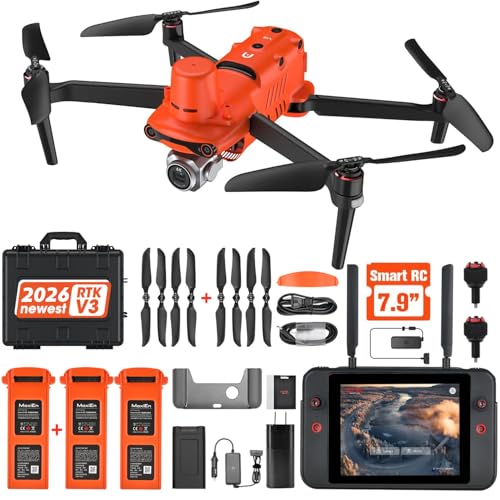
Autel EVO II Pro
Best DJI alternativeThe closest thing to a like-for-like DJI competitor, with an RTK variant for survey work. Buyers reach for Autel mainly when a DJI purchase is off the table on procurement grounds.
Check price on AmazonAffiliate link. Price and stock change constantly, so we show them only on Amazon.
- 1-inch sensor
- RTK variant for centimetre positioning
- No DJI account required
- Genuine alternative when DJI is disallowed
- Strong survey and mapping support
- Still a Chinese manufacturer, so most DJI bans catch it too
- Smaller app and accessory ecosystem

Potensic ATOM 2
Best budget alternativeUndercuts the DJI Mini line while keeping the things that matter at this price: GPS hold, a stabilised 4K camera, and sub-250 g weight. The app and transmission are where the money was saved.
Check price on AmazonAffiliate link. Price and stock change constantly, so we show them only on Amazon.
- Under 249 g
- 4K camera with gimbal
- GPS position hold
- Far cheaper than an equivalent DJI Mini
- Still avoids registration
- Transmission range well short of DJI
- Less polished app
Drones and UAS FAQs
What are Chinese drones?
Chinese drones is a broad origin label for unmanned aircraft designed or produced by Chinese companies or state-linked industry groups. It covers consumer, enterprise, agriculture, and military roles. The label alone does not establish ownership, U.S. authorization, export eligibility, or operational status, so those questions need model-specific primary sources.
Are Chinese military drones the same as DJI?
No. DJI is a commercial drone brand, while Chinese military types such as Wing Loong-class aircraft sit in a different buyer, policy, and evidence stack. A commercial product page can support a marketing claim. Military inventory or export claims require official disclosures or carefully attributed reporting, not a transfer of reputation from consumer hardware.
Why do Chinese drones matter for U.S. investors?
They matter as competitive and policy context for U.S. makers, component suppliers, and funds, not as a single ticker theme. Investors should identify the company, its public status, the buyer it serves, and the actual policy or supply-chain link. A headline about a Chinese brand does not establish a direct benefit for a U.S. stock.
Do China export controls mean every drone shipment is banned?
No. MOFCOM Announcement 2026 No. 34 describes case-by-case strict review and removal of licensing facilitation for listed drone items and related technology exported to the United States. It should be read as a policy and timing screen. It does not, by itself, prove that every drone or component shipment is prohibited or delayed.