MQ-9 Reaper vs Bayraktar TB2: Specs, Payload, Reach
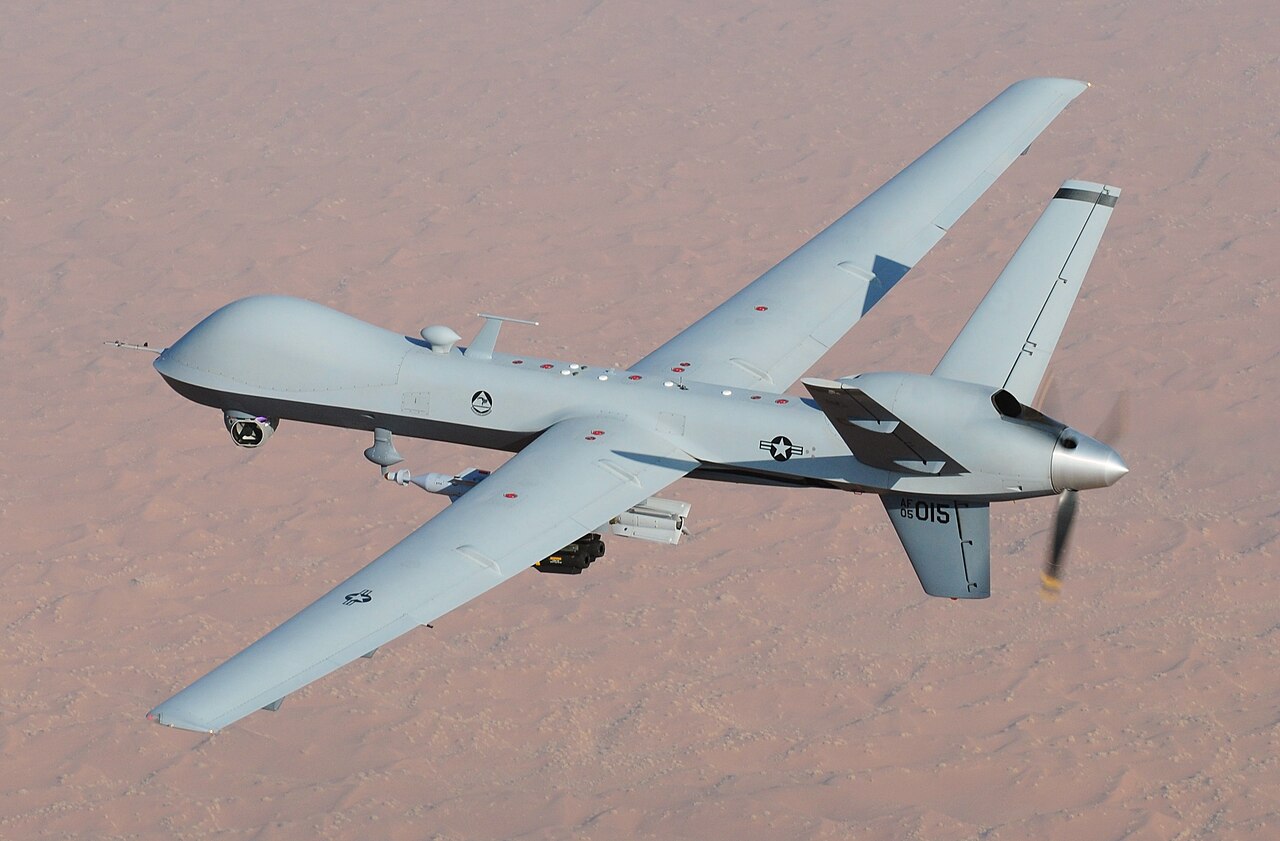
The MQ-9A Reaper and the Bayraktar TB2 occupy different weight classes rather than competing as like-for-like platforms. Baykar's summary banner and its technical specifications table give different figures for ceiling and endurance. The MQ-9A is a 10,500-pound turboprop platform that reaches a maximum altitude of 50,000 feet and carries up to 3,850 pounds of combined stores. The TB2 is a 700-kilogram aircraft driven by a 100-horsepower internal combustion engine that carries a 150-kilogram payload. Selecting between them depends on whether an operator requires high-altitude sensor persistence with heavy strike loads or affordable operational mass.
The Short Answer: Two Different Weight Classes
The MQ-9A Reaper and the Bayraktar TB2 belong to two distinct operational weight tiers. The MQ-9A has a maximum gross takeoff weight of 10,500 pounds (4,763 kilograms), while the TB2 has a maximum takeoff weight of 700 kilograms. That gives the MQ-9A roughly 6.8 times the maximum takeoff weight of the TB2. The payload disparity is even wider. The MQ-9A carries up to 3,850 pounds (1,746 kilograms) of internal and external gear, which is roughly 11.6 times the 150-kilogram payload capacity published for the TB2.
The operational pick follows the mission boundary. An operator that requires high-altitude loitering, multiple heavy radar assemblies, and carriage of payloads across seven external stations needs the MQ-9A Reaper. An operator that requires affordable mass, built-in sensor-fusion autonomy without GPS dependency, and a 150-kilogram payload capacity needs the Bayraktar TB2. Our types of military drones page sets out the mission classes both aircraft sit in. Our Predator vs Reaper comparison covers the MQ-9A against the MQ-1 Predator.
Direct Specification and Architecture Comparison
The MQ-9A features a 66-foot (20 m) wingspan and 36-foot (11 m) length, compared with the 12-meter wingspan of the TB2. The MQ-9A relies on a Honeywell TPE331-10 turboprop engine, while the TB2 uses a 100-horsepower internal combustion engine.
Operating metrics on Baykar's materials present two contested values. The manufacturer's summary banner lists a maximum altitude of 22,000 feet, while its technical specifications table records a 20,000-foot service ceiling alongside a 16,000-foot operational altitude. Similarly, Baykar lists endurance as 18-plus hours in its formal specifications table but states 20-plus hours in its promotional banner. Baykar separately documents an operational flight record of 27 hours and 3 minutes. The published specifications are compared below.
| Specification | MQ-9A Reaper | Bayraktar TB2 |
|---|---|---|
| Classification | Turboprop multi-mission Remotely Piloted Aircraft | Medium Altitude Long Endurance (MALE) armed UAV |
| Maximum takeoff weight | 10,500 lb (4,763 kg) | 700 kg |
| Payload capacity | 3,850 lb (1,746 kg) total; 850 lb internal, 3,000 lb external | 150 kg |
| Powerplant | Honeywell TPE331-10 turboprop | 100 hp internal combustion engine |
| Maximum airspeed | 240 KTAS | 90 KTAS to 110 KTAS |
| Maximum altitude / service ceiling | 50,000 ft (15,240 m) | 20,000 ft (banner states 22,000 ft max altitude) |
| Operational altitude | Not published | 16,000 ft |
| Flight endurance | 27 hours (34 hours on Extended Range variant) | 18+ hours (banner states 20+ hours; 27h 3m record) |
| Communications links | C-Band line-of-sight and Ku-Band SATCOM (BLOS) | Line-of-sight (LOS) and beyond-line-of-sight (BLOS) |
| Flight control and autonomy | Remotely piloted or fully autonomous; triple-redundant avionics | Triple-redundant autopilot; autonomous taxi, takeoff, cruise, landing |
| Munitions interface | MIL-STD-1760 stores management; 7 external stations | Laser-guided munitions (INS/GPS); MAM-L and MAM-C |
| Published unit price | Unpublished by manufacturer | Unpublished by manufacturer |
Payload Capacity and Weapons Integration
The MQ-9A Reaper carries roughly 11.6 times the payload capacity of the Bayraktar TB2. General Atomics Aeronautical Systems specifies that the MQ-9A provides 850 pounds (386 kilograms) of internal payload space and 3,000 pounds (1,361 kilograms) across external hardpoints. This yields a total payload capacity of 3,850 pounds (1,746 kilograms). The MQ-9A includes seven external stations for carrying stores and incorporates a MIL-STD-1760 stores management system. Its redundant Block 5 electrical architecture supplies 11.0 kW / 45.0 kVA of electrical power.
The Bayraktar TB2 provides a total payload capacity of 150 kilograms. Baykar Technology specifies that the TB2 can carry simultaneous EO/IR/LD suites. Alternatively, it carries a surveillance radar payload. For strike missions, the TB2 employs national laser-guided munitions using inertial navigation and satellite positioning, specifically naming the MAM-L and MAM-C munitions.
The payload disparity alters the mission profile. The MQ-9A carries heavy mission packages alongside strike munitions. Available payloads include the MTS-B EO/IR sensor, Lynx multi-mode radar, maritime surveillance radar, Automated Identification System (AIS), SIGINT/ESM, and communications relay. The TB2 carries a simultaneous EO/IR/LD suite or surveillance radar alongside MAM-L and MAM-C laser-guided munitions within its 150-kilogram payload capacity. Our Global Hawk vs Reaper comparison sets the MQ-9A against an unarmed high-altitude reconnaissance aircraft instead.
Altitude, Endurance, and Airspeed Profiles
The MQ-9A operates at two and a half times the TB2's ceiling. It reaches a maximum airspeed of 240 Knots True Airspeed (KTAS), against 90 KTAS to 110 KTAS for the Bayraktar TB2. The MQ-9A's maximum altitude is 50,000 feet (15,240 meters). It carries 3,900 pounds (1,769 kilograms) of internal fuel. Standard endurance is 27 hours. The Extended Range variant pushes that endurance to 34 hours through field-retrofittable wing fuel pods and reinforced landing gear.
Baykar's published technical specifications table lists the TB2's service ceiling at 20,000 feet, an operational altitude of 16,000 feet, and cruise-to-maximum travel speeds between 90 KTAS and 110 KTAS. A summary banner on Baykar's published technical specifications states a maximum altitude of 22,000 feet and an endurance of 20-plus hours. The technical table notes 18-plus hours, though Baykar separately documents a record flight of 27 hours and 3 minutes.
Avionics, Flight Control, and Communication Architecture
Both aircraft incorporate fault-tolerant avionics architectures to sustain remote operations and autonomous flight routines. General Atomics Aeronautical Systems documents a triple-redundant avionics system architecture for the MQ-9A, backed by redundant flight control surfaces and a fault-tolerant flight control system. The Reaper can execute sorties under active pilot control or fly fully autonomously. Communications use C-Band line-of-sight data links for local control. Ku-Band satellite communications (SATCOM) links provide beyond-line-of-sight command. General Atomics states the system maintains over 90 percent operational availability and can self-deploy or pack into a C-130 transport aircraft.
The Bayraktar TB2 features a triple-redundant autopilot system and triple-redundant sensor fusion. Baykar specifies fully automatic taxi, takeoff, cruise, and landing capabilities that operate without dependence on ground-based navigation systems. Its navigation package applies internal sensor fusion to operate without dependency on GPS signals. Baykar details additional redundant systems, including a cross redundant YKI system, redundant servo actuators, and redundant lithium-based battery units. The TB2 supports both line-of-sight and beyond-line-of-sight communications.
Airframe Variants and Production Standards
General Atomics Aeronautical Systems structures the Reaper lineage around the baseline MQ-9A airframe, which the manufacturer also designates as the Predator B. The name Reaper originated with the United States and the Royal Air Force to designate armed Predator B configurations. General Atomics publishes an MQ-9A Block 5 Data Sheet for download on the General Atomics MQ-9A page.
Baykar documents a different path for the Bayraktar TB2 by listing four distinct versions: the TB2-A, TB2-B, TB2-C, and TB2-D. Baykar does not publish what distinguishes these four versions from one another, and operators should review Baykar's Bayraktar TB2 page for any newly disclosed differences. Baykar publishes no separate endurance, ceiling, or payload figure per version. Our Bayraktar TB2 profile covers the aircraft in its own right.
Operational Flight History and Customer Base
The MQ-9A Reaper first flew in 2001 after development funded by General Atomics Aeronautical Systems, building directly on the manufacturer's experience with the earlier Predator RPA. General Atomics reports seven acquiring operators to date: the US Air Force, the Royal Air Force, the US Department of Homeland Security, NASA, the Italian Air Force, the French Air Force, and the Spanish Air Force. The US and Royal Air Force designated the aircraft the Reaper.
Baykar documents extensive operational flight hours across several theaters. The manufacturer states that the Bayraktar TB2 has completed more than 1,250,000 hours of operational flight. Baykar names Karabakh, Libya, Syria, and Ukraine as active theaters for the TB2. Baykar describes the TB2 as "the world's most actively deployed UAV", though this is the manufacturer's own claim. Detailed analysis of the Reaper's service milestones is covered in our MQ-9 Reaper profile, while theater employment of the TB2 is reviewed in our Bayraktar TB2 profile.
Published Unit Pricing
Neither General Atomics Aeronautical Systems nor Baykar Technology publishes a unit price on their official aircraft specification pages. Readers can consult our MQ-9 Reaper profile for the US Air Force system procurement figure and the four-aircraft-package caveat.
Our military drone cost guide covers how defense budgets account for these packages.
Mission Profiles and Selection Boundaries
The choice between the MQ-9A Reaper and the Bayraktar TB2 depends on the specific operational environment and mission requirements rather than an overall ranking. The MQ-9A is suited for operators that require high-altitude intelligence collection, multi-sensor integration, long transit speeds, and heavy precision-strike capability. Its 50,000-foot ceiling, 240 KTAS airspeed, and 3,850-pound payload accommodate complex radar and multi-weapon configurations during extended patrols.
The Bayraktar TB2 is the right choice for tactical armed surveillance missions that require affordable mass. The TB2 relies on a 700-kilogram maximum takeoff weight, a 150-kilogram payload capacity, and internal sensor-fusion navigation to conduct autonomous flight operations without dependence on ground systems. One condition reverses that choice. If an operational theater requires long-distance maritime radar coverage and heavy strike stores, smaller airframes like the TB2 cannot meet the mission requirements.
The full published specifications sit on General Atomics' MQ-9A page and Baykar's Bayraktar TB2 page.
Drones and UAS FAQs
Is the Bayraktar TB2 better than the MQ-9 Reaper?
Neither aircraft is objectively better across all missions because they occupy different weight classes. The MQ-9A Reaper offers higher speeds, a 50,000-foot ceiling, and a 3,850-pound payload capacity for heavy strike and multi-sensor operations. The Bayraktar TB2 is the better choice for missions requiring affordable mass, offering 18-plus to 20-plus hours of endurance, a 150-kilogram payload, and autonomous operations without dependence on ground systems.
How much payload can the Bayraktar TB2 carry compared with the MQ-9 Reaper?
The Bayraktar TB2 has a published payload capacity of 150 kilograms. The MQ-9A Reaper has a published payload capacity of 3,850 pounds (1,746 kilograms), comprising 850 pounds of internal capacity and 3,000 pounds across seven external stations. The MQ-9A carries roughly 11.6 times the payload of the TB2.
How long can each drone stay in the air?
The MQ-9A Reaper has a published maximum endurance of 27 hours, which increases to 34 hours on the Extended Range variant. Baykar publishes conflicting endurance figures for the TB2, stating 18-plus hours in its specifications table and 20-plus hours in its summary banner. Baykar separately records a flight record of 27 hours and 3 minutes.
How much does an MQ-9 Reaper cost compared with a Bayraktar TB2?
Neither manufacturer publishes unit prices on their official specification pages. Our MQ-9 Reaper profile details the US Air Force system procurement figure and four-aircraft package caveat.
Can the Bayraktar TB2 fly as high as the MQ-9 Reaper?
No, the MQ-9A Reaper operates at higher altitudes. General Atomics lists the MQ-9A maximum altitude at 50,000 feet. Baykar lists the TB2 service ceiling at 20,000 feet (with its banner citing 22,000 feet) and an operational altitude of 16,000 feet.