MQ-9 Reaper
The MQ-9 Reaper is a US-built long-endurance remotely piloted aircraft used for intelligence and strike missions.
MQ-9 Reaper at a glance
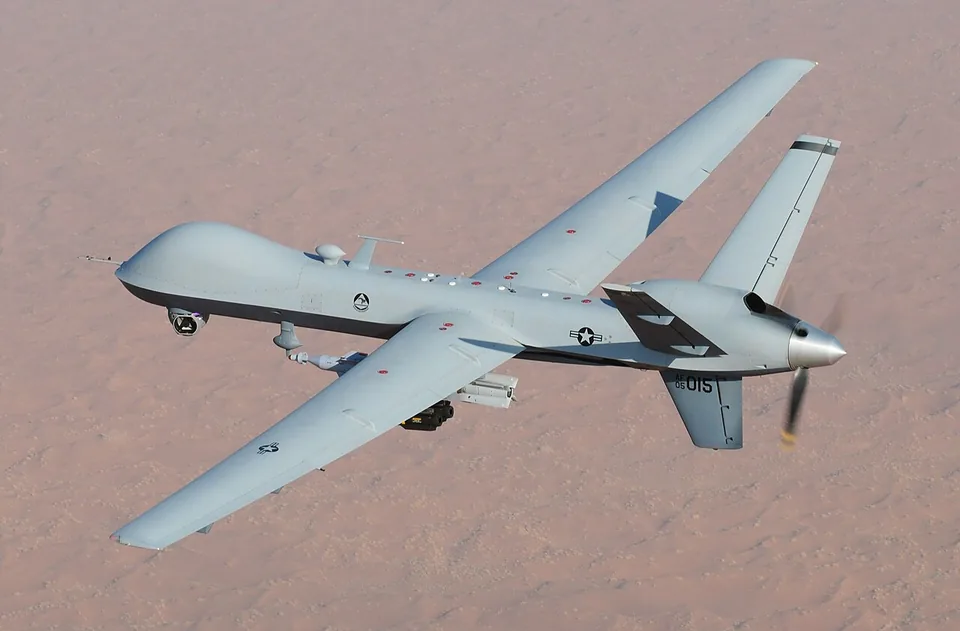
| Manufacturer | General Atomics Aeronautical Systems |
|---|---|
| Origin | United States |
| Category | Armed ISR UAV |
| Role | Long-endurance surveillance and attack UAV. |
| Aliases | MQ-9 · Predator B |
| Evidence status | Confirmed system use |
What the public record establishes
CENTCOM’s Operation Epic Fury fact sheet lists MQ-9 surveillance and attack drones among US assets employed in the Iran war. The entry establishes theater use at the system level, not the location or task of any individual aircraft.
The distinction between platform identity and event attribution matters. A manufacturer page can establish what a drone is; an official military release, UN report, or conflict-monitoring source is needed to establish where it appears in a war. Where those records do not align, this page keeps the uncertainty visible.
This is a non-operational reference page. It explains the manufacturer, platform family, and public conflict record without providing instructions for building, targeting, deploying, or modifying a weapon system.
System procurement cost and unit pricing
The published unit cost for the MQ-9 Reaper is $56.5 million in fiscal 2011 dollars, according to the official US Air Force fact sheet. That figure does not represent the purchase price of an individual airframe. The US Air Force defines that unit cost as a complete operational system.
This package includes four aircraft equipped with sensors, a ground control station, and the Predator Primary Satellite Link.
The US Air Force publishes no single-airframe price. Per-aircraft figures in circulation come from third-party calculations that divide the system total across four planes. On broader military drone cost accounting, the procurement baseline also includes spare equipment. Full operational fielding requires dedicated operations and maintenance crews for deployed 24-hour missions.
Contractor General Atomics Aeronautical Systems, Inc. (GA-ASI) originally developed the aircraft with internal funding before its first flight in 2001. The MQ-9 Reaper reached initial operating capability in October 2007. The Air Force fact sheet records an inventory of 50 aircraft assigned specifically to Air Force Special Operations Command (AFSOC). General Atomics lists operators beyond the US Air Force.
They include the US Department of Homeland Security, the National Aeronautics and Space Administration, the Royal Air Force, and the Italian, French and Spanish air forces.
Flight endurance, payload capacity, and technical specifications
The baseline MQ-9 Reaper airframe features a wingspan of 66 feet (20.1 metres), a length of 36 feet (11 metres), and a height of 12.5 feet (3.8 metres). The aircraft can operate up to 50,000 feet. Power comes from a Honeywell TPE331-10GD turboprop engine delivering up to 900 shaft horsepower. General Atomics documents speeds of 240 knots true airspeed (KTAS).
General Atomics lists standard endurance at over 27 hours. The Extended Range (ER) modification increases mission duration to 34 hours using field-retrofittable wing fuel pods and reinforced landing gear. Air Force specifications record a baseline range of 1,150 miles (1,000 nautical miles) with 4,000 pounds (602 gallons) of fuel.
The ER model extends range to 1,611 miles (1,400 nautical miles) with 6,000 pounds (903 gallons) of fuel. The modification adds an extra propeller blade and an alcohol-water injection system.
The US Air Force and General Atomics publish different payload figures. The US Air Force fact sheet documents a payload capacity of 3,750 pounds (1,701 kg) alongside an empty weight of 4,900 pounds (2,223 kg). Maximum takeoff weight is 10,500 pounds (4,760 kg), rising to 11,700 pounds (5,307 kg) for the ER variant.
In contrast, General Atomics rates total payload at 3,850 pounds (1,746 kg), with 3,000 pounds (1,361 kg) allocated to external stores. For transport, the disassembled aircraft packs into a single container that fits inside a C-130 Hercules cargo aircraft.
Remote flight operations require a crew of two, pairing a pilot with a sensor operator. The sensor suite centers on the Multi-Spectral Targeting System (MTS). Its MTS-B installation integrates an infrared sensor, daylight color and monochrome television cameras, a shortwave infrared camera, a laser illuminator, a laser rangefinder/designator, and synthetic aperture radar (SAR). Munitions include up to eight AGM-114 Hellfire missiles.
The aircraft can also carry precision weapons including the GBU-12 Paveway II, GBU-38 Joint Direct Attack Munition (JDAM), GBU-49 Enhanced Paveway II, and GBU-54 Laser JDAM. The Predator vs Reaper comparison covers how this weapons load differs from the MQ-1 Predator's.
Fleet attrition and the successor question
The United States Air Force (USAF) has not selected a successor platform to replace the MQ-9 Reaper. Manufacturer General Atomics shut down the MQ-9A production line in 2025 once the service decided against further purchases. About two dozen airframes were lost during Operation Epic Fury against Iran, where the Air Force found the aircraft comparatively slow and vulnerable to Iranian anti-aircraft weapons.
Houthi militants in Yemen had destroyed at least a dozen more in earlier operations.
Reporting from Air & Space Forces Magazine puts the USAF MQ-9 fleet at about 135 aircraft. Lt. Gen. David Tabor confirmed that the smaller inventory, down from 158 active-duty and 24 Air National Guard airframes in fiscal 2025, still meets all combat requirements. Tabor noted the service is pursuing immediate options in the current fiscal year to buy back available MQ-9A airframes.
General Atomics spokesman C. Mark Brinkley stated the contractor has fewer than 10 complete Reapers left in inventory, including about five buildable from stored parts. The service could also return decommissioned airframes from the Boneyard to operational units. Brinkley also offered the Air Force the MQ-9B SkyGuardian, a larger and different aircraft.
He put the price at about $30 million apiece fully equipped, and said it could come down if capability were cut.
For a permanent replacement, the service is modeling its development program on the Collaborative Combat Aircraft (CCA) acquisition approach. Maj. Gen. Christopher Niemi stated the service plans to canvass industry for operational attributes and down-select contenders during development. Lt. Gen. Luke Cropsey said a recent request for information (RFI) drew over 50 responses.
The wider US fleet a successor would join is mapped on the US military drones hub.
Wars covered
- 2026 Iran War — February 2026–present
MQ-9 Reaper FAQ
Who makes the MQ-9 Reaper?
General Atomics Aeronautical Systems
Where has the MQ-9 Reaper been documented?
2026 Iran War
Is the MQ-9 Reaper identification fully confirmed?
Confirmed system use. This status applies to the level of evidence described on this page, not to every individual battlefield claim.
Primary and monitoring sources
- CENTCOM Operation Epic Fury fact sheet (official)
- General Atomics MQ-9A product page (manufacturer)