US vs China drones: tech competition and policy map
US vs China drones is a policy and industrial-base comparison, not a simple scoreboard of which country’s aircraft flies farther. The evidence-first question is who can authorize products, source components, qualify suppliers, and convert stated priorities into delivered systems.
US vs China drones is a control-systems story
US vs China drones is best read as a control-systems story: who can authorize sales, who can export parts, and who can scale trusted production.
America-versus-China tech headlines often collapse into AI or chips. Drones sit in the same rivalry through airspace, data, electronics, supply chains, and industrial-base policy. A country label does not describe every airframe, component, or buyer.
This page stays on unmanned systems and the second-order research questions those rules create. It does not try to rank national capability from public marketing or infer operational inventories from a press release.
Policy tools compared
| Tool | What it throttles | Investor research question |
|---|---|---|
| FCC Covered List for foreign UAS | New equipment authorizations for foreign-produced UAS and critical components. | Which makers can clear the relevant authorization gate, and what is the status of the exact model? |
| Blue UAS / Buy American pathways | Trusted or domestic exceptions described in FCC FAQs; list status and qualification are distinct claims. | Is the claim externally verifiable on the current Blue UAS list or in the buyer’s contract? |
| MOFCOM Announcement 2026 No. 34 | Case-by-case strict review of listed drone dual-use exports and related technology to the United States. | Where could a buyer face licensing delay, supply interruption, qualification work, or redesign pressure? |
| DoD Drone Dominance framing | U.S. industrial-base and military UAS priority messaging. | Which stack layers are named, funded, contracted, or delivered rather than simply mentioned? |
| Supplier qualification | Turns policy language into approved parts, production capacity, cybersecurity review, and support. | Does a named supplier have documented acceptance for the relevant customer and mission? |
U.S. side: authorization and trusted lists
The U.S. side uses communications authorization and trusted-list tools to shape which foreign drones can enter the commercial market.
FCC Covered List FAQs explain the foreign-UAS update and exemptions. They also distinguish new equipment authorization from previously authorized equipment models. That detail is more useful than the loose phrase “drone ban.”
The first information-gain moment is that an authorization gate is not a technical ranking. A U.S.-made label, a Blue UAS reference, and a lawful mission claim are different assertions. Each needs its own source and current status check.
China side: export licensing pressure to the United States
China can slow U.S.-bound drone dual-use shipments through licensing review without announcing a total ban.
MOFCOM Announcement 2026 No. 34 applies case-by-case strict review and removes licensing facilitation for listed drone items and related technology exports to the United States.
MOFCOM’s English remarks on the Covered List show the diplomatic framing; investors should still read the announcement text for the operative rule. A spokesperson statement is context, not a substitute for the controlling text.
Industrial capacity is not a single national score
Industrial capacity includes much more than airframe assembly. It includes sensors, radios, propulsion, batteries, software, test facilities, secure supply, repair, operator training, and the ability to produce a conforming system repeatedly.
A named system can demonstrate a concept, a prototype, a flight, a contract award, or fielded inventory. Those evidence levels are not interchangeable. The second information-gain moment is to label the evidence status before treating a system as a production advantage.
For example, the DoD’s Drone Dominance page is evidence of U.S. priority framing. It is not, by itself, evidence that every named program has reached delivery, achieved a performance level, or generated revenue for a public company.
Policy can create a supply-chain tradeoff
Restricting one supply path can increase demand for alternatives, but it can also expose dependence on another constrained input. A buyer that replaces an aircraft may need to requalify software, payloads, batteries, repair procedures, and data handling.
That is a real tradeoff, not a slogan. Security and sourcing goals can improve a procurement pathway while creating near-term cost, schedule, or capacity pressure. The outcome depends on the buyer’s requirements and the supplier’s documented ability to meet them.
Screen suppliers for qualified production, lead-time evidence, warranty and repair obligations, and integration responsibility. Do not assume a policy tailwind converts into immediate sales simply because a firm is described as domestic.
How buyers should separate evidence from marketing
Manufacturer websites are the right first stop for a company’s own product claim. They are not independent validation. Record the claim, date, exact configuration, and whether an agency, contract, certification, or live list corroborates it.
A common attribution failure is to cite an announcement about a broad program as proof that one company has a funded order. Another is to call a product “approved” when the relevant list is expired, different, or not applicable to the buyer.
Use the current FCC FAQ, the current Blue UAS list, official MOFCOM notices, and contract documentation where available. If the evidence does not establish an inventory, capability, or compliance result, say so rather than filling the gap with inference.
Investor screen: trace the revenue path
Investors should separate hardware origin risk from public-company exposure. A Chinese commercial brand is not automatically a U.S. ticker, and a U.S. policy announcement is not automatically revenue for every domestic manufacturer.
Trace a thesis through four steps: a stated rule or priority, a buyer requirement, a funded procurement or purchase order, and a supplier’s disclosed revenue or backlog. Break the chain where evidence stops.
This screen applies to airframes, components, autonomy, counter-UAS, and services. Use drone stocks and drone ETFs only after identifying the actual exposure rather than treating “US vs China” as an asset class.
How investors should use this map
Use this map to separate hardware origin risk, component dependency, and public-company exposure. It is a research framework, not an investment recommendation or a prediction that any national program will succeed.
Continue to Chinese drones, American made drones, and the Defense Department Drone Dominance spotlight for role-specific context.
When facts conflict, privilege the controlling rule, dated official source, or disclosed filing over a headline. Mark unresolved claims as unresolved. That discipline matters more than a confident national scoreboard.
Revisit the map when the rule, list, contract, or supplier evidence changes. The policy environment moves faster than a static national comparison, and a conclusion based on an old authorization status or a stale product page can be materially wrong.
The comparison becomes useful when it identifies the next verifiable question rather than pretending public sources can settle every capability, inventory, or market-share claim.
Where To Buy
The models below are the ones we point readers at, listed in the order we would consider them. We earn a commission if you buy through these links, at no extra cost to you — it never changes which aircraft make the list.
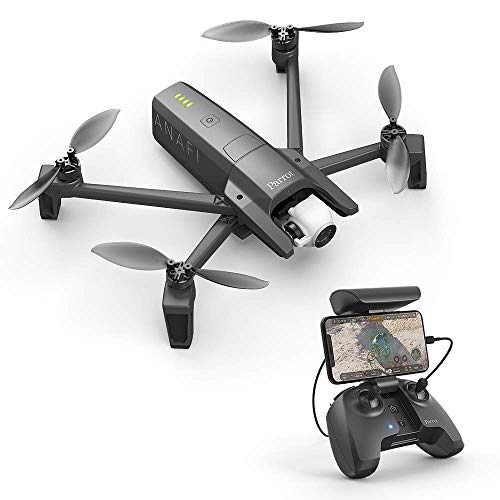
Parrot ANAFI
Best non-Chinese optionFrench-designed, and the practical answer for buyers whose procurement rules exclude Chinese manufacturers. Older and less capable than current DJI hardware, which is the price of that constraint.
Check price on AmazonAffiliate link. Price and stock change constantly, so we show them only on Amazon.
- French manufacturer
- Folding airframe
- 180-degree tilt gimbal
- Passes procurement rules that exclude Chinese drones
- Unusual straight-up gimbal tilt
- Camera and transmission lag current DJI models
- Thin accessory ecosystem

DJI Air 3S
Best all-round camera droneThe step up that buys a larger sensor and dual cameras without the flagship price. Over 249 g, so registration applies. Take that as the real cost of the image quality.
Check price on AmazonAffiliate link. Price and stock change constantly, so we show them only on Amazon.
- Dual-camera system with a 1-inch main sensor
- Omnidirectional sensing
- Over 249 g
- Much better low-light image than the Mini line
- Two useful focal lengths
- Requires FAA registration
- Bulkier to carry than a Mini
Drones and UAS FAQs
Who is winning US vs China drones?
There is no single winner. The useful question is which policy tool changes buyer access, qualified production, component supply, and mission fit in the case you are researching. Public sources often establish a policy or a product claim but not a directly comparable national inventory or operational-performance score.
How does America vs China tech show up in drones?
It shows up through FCC authorization limits, trusted-list procurement, Chinese dual-use export reviews, and defense industrial-base programs such as Drone Dominance. Each tool affects a different stage of the market. A policy headline should be checked against the controlling document and the exact product, supplier, and buyer condition.
Where should retail investors start?
Start with role and compliance, then map to public specialists or funds only after tracing actual exposure. Ask whether a rule creates a buyer requirement, whether the requirement has funded procurement, and whether a company discloses relevant revenue or backlog. Do not treat Chinese commercial brands as U.S. tickers.
Does a Blue UAS reference mean every product is approved for every buyer?
No. A Blue UAS reference, a domestic-content claim, and a buyer-specific approval are different things. Check the current official list, the exact product, any stated conditions, and the buyer’s contract or policy. Marketing language can omit scope, expiry, components, or a distinction between a supplier and a particular system.
Do China export controls mean all drone shipments stop?
No blanket claim should be inferred from the cited MOFCOM announcement. It describes case-by-case strict review and the loss of licensing facilitation for listed drone items and related technology exports to the United States. Buyers should determine whether their exact item, technology, transaction, and date fall within the operative rule.