Shield AI V-BAT and Taiwan's Coast Guard Delivery
The Shield AI V-BAT is a vertical takeoff and landing (VTOL) drone that Taiwan's Coast Guard Administration (CGA) chose in July 2026 for its "Shipborne UAV" (unmanned aerial vehicle) program.
This selection comes with 12 aircraft to be delivered over the coming months but no published contract value in the sources read.
What the Shield AI V-BAT Is
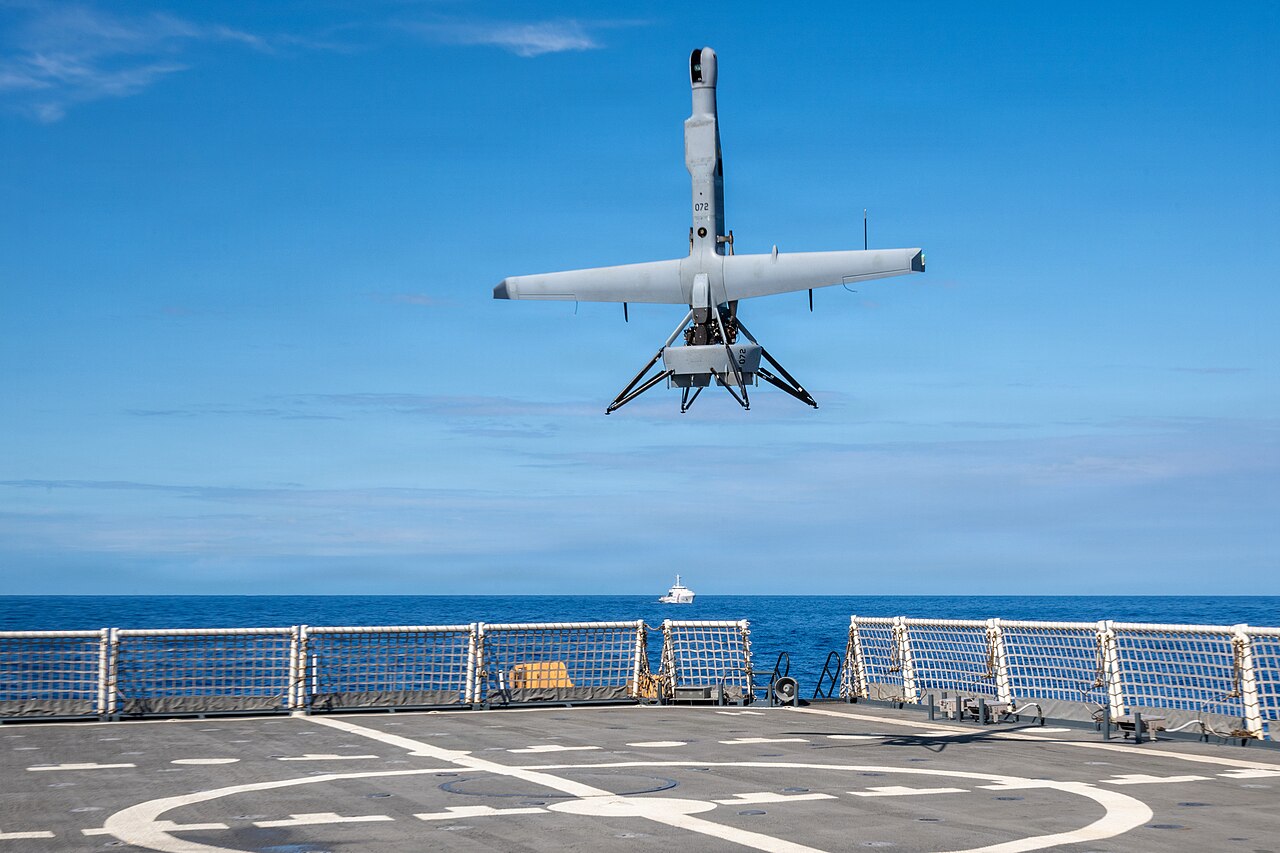
The Shield AI V-BAT is a Group 3 uncrewed aircraft system (UAS) with a ducted-fan configuration and a heavy-fuel engine, according to Shield AI as reported by Naval Technology. It launches and recovers from ship decks or other confined locations without assistance. Shield AI says it is designed to operate in contested electronic-warfare environments.
Taiwan News reports the V-BAT stands 2.9 meters tall with a 3.8-meter wingspan. It flies on Shield AI's Hivemind autonomous flight software. Shield AI puts its endurance at more than 12 hours.
The job Shield AI describes is intelligence, surveillance and reconnaissance (ISR) at lower cost and logistical burden than larger systems. Taiwan's Coast Guard Administration chose it in July 2026 for its Shipborne UAV program. Shield AI announced the first delivery on October 13, 2026, with 12 to be delivered over the coming months.
What Taiwan's Coast Guard Is Getting
Taiwan's Coast Guard Administration is getting 12 V-BAT aircraft over the coming months, with the first delivered as of October 13, 2026. Shield AI announced that first delivery on Tuesday, October 13. The CGA had selected the V-BAT in July 2026 after a competitive tender. Naval Technology says the size of the first batch was not stated.
On October 7, 2026, the CGA showed the newly arrived V-BATs at the Port of Taipei to Ocean Affairs Council Minister Kuan Bi-ling and National Security Council Secretary-General Joseph Wu. Shield AI engineers demonstrated setup within minutes and shipborne deployment.
Shield AI says Taiwan will use the V-BAT for surveillance, coastal patrols and law enforcement operations. Naval Technology adds that the CGA plans to use the fleet to improve maritime domain awareness across the Taiwan Strait and Taiwan's maritime borders.
Shield AI will train Coast Guard operators and maintenance personnel. It will also build local support with Taichung-based Aerospace Industrial Development Corporation (AIDC), which partnered with Shield AI on September 11, 2025 on autonomous flight controls, fleet management and maintenance.
| Item | What was reported | What is not published |
|---|---|---|
| Aircraft count | 12 V-BATs to be delivered over the coming months | Size of the first delivered batch |
| Selection | July 2026, after a competitive tender for the Shipborne UAV program | Contract value |
| First delivery | Announced by Shield AI on October 13, 2026 | Per-unit price |
| Missions | Surveillance, coastal patrols and law enforcement, per Shield AI | Named ships the V-BATs will fly from |
| Support | Operator and maintenance training, plus local support with AIDC | Payload weight, range or ceiling for the Taiwan configuration |
Why a Ship-Launched VTOL Matters
A VTOL drone can fly from a ship deck or a rooftop without a runway, per Shield AI as reported by Taiwan News. Shield AI's April 2025 V-BAT Block upgrade release says the aircraft needs no runway, catapult or net. The same release says the ducted fan supports landings on moving ships, rooftops and confined areas.
The Block upgrade release says the heavy-fuel engine is optimized for JP-5, which Shield AI calls a common maritime aircraft fuel.
Shield AI engineers showed Taiwan's officials the aircraft set up within minutes at the Port of Taipei. For a different ISR drone, see our Skydio ISR Command page covers another ISR product.
Hivemind, SATCOM and Payloads
Hivemind is Shield AI's autonomous flight software, and Taiwan News reports the V-BAT uses it. Shield AI's April 2025 release calls the V-BAT "Hivemind Pilot-ready." The sources read do not detail which Hivemind functions run on the Taiwan aircraft.
The same release says satellite communications (SATCOM) integration lets operators command the V-BAT beyond line of sight. Supported payloads include ViDAR-enabled passive wide-area motion imagery, synthetic aperture radar (SAR) and electronic warfare payloads.
Shield AI described the upgrade as Group 4 and 5 capabilities in a "Group 3 package." The Taiwan coverage does not say which payloads the CGA aircraft carry.
Where Shield AI Says the V-BAT Is Deployed
Shield AI says the V-BAT is deployed on nearly every class of US Navy ship and with all seven Marine Expeditionary Units (MEUs). In its April 2025 release, Shield AI also said the US Coast Guard selected the V-BAT for an ISR contract. It added that the Japan Maritime Self-Defense Force (JMSDF) named the V-BAT its first ship-based ISR platform. These are Shield AI's own statements.
Shield AI President and co-founder Brandon Tseng said the V-BAT can help with Coast Guard work such as coastal surveillance and drug seizures. He cited the US Coast Guard's interception of more than 100,000 pounds of narcotics last year.
AIDC President Jennifer Chuang said the CGA chose the V-BAT because both companies could provide reliable local support. She also said Shield AI was willing to train local staff.
What to Verify in Shield AI V-BAT Claims
Every capability on this page comes from Shield AI, and no independent test result for the Taiwan buy appears in the sources read. Read the specs as vendor claims until a third party reports otherwise.
Endurance varies by source and configuration. Taiwan News and Naval Technology report more than 12 hours, per Shield AI, for the Taiwan delivery. Shield AI's April 2025 Block release says beyond 13 hours with the JP-5 engine. The Taiwan aircraft's own figure is published only as more than 12 hours.
Shield AI is a private company with no ticker. The Taiwan order cannot be bought through a listed stock. Our military drone companies page lists other companies in the sector, and our Shield AI company page covers its reported funding, Hivemind and the X-BAT.
What Would Change This Read
Four disclosures would change how we read the Taiwan order.
A published contract value or per-unit price would show what the CGA is paying for 12 aircraft.
Independent test results would replace Shield AI's endurance and setup claims with measured figures.
Named vessels would show which CGA ships carry the V-BAT and how widely the fleet spreads.
A rival ship-launched VTOL winning a comparable coast guard tender would show the V-BAT faces direct competition for this mission.
Read the Naval Technology delivery report and the Taiwan News report side by side before you cite any Shield AI V-BAT figure.
Drones and UAS FAQs
What is the Shield AI V-BAT?
The Shield AI V-BAT is a Group 3 vertical takeoff and landing drone with a ducted fan and a heavy-fuel engine, per Shield AI. It launches and recovers from ship decks or confined spaces without assistance. Taiwan News reports it is 2.9 meters tall with a 3.8-meter wingspan.
How many V-BAT drones is the Taiwan Coast Guard buying?
Taiwan's Coast Guard Administration expects 12 V-BATs over the coming months. Shield AI announced the first delivery on October 13, 2026. The size of the first batch, the contract value and the per-unit price have not been published.
How long can the V-BAT fly?
Shield AI says the V-BAT flies more than 12 hours, the figure reported for the Taiwan delivery. Shield AI's April 2025 Block upgrade release gives beyond 13 hours with a JP-5 engine, so endurance depends on configuration.
Can I invest in Shield AI?
Shield AI is a private company with no ticker. Our Shield AI company page covers its reported funding, Hivemind and the X-BAT.
What does Hivemind do on the V-BAT?
Hivemind is Shield AI's autonomous flight software, and Taiwan News reports the V-BAT uses it. Shield AI's April 2025 release calls the V-BAT "Hivemind Pilot-ready." The sources read do not list specific Hivemind functions on the Taiwan aircraft.