RQ-11 Raven Specs and Its Two Published Endurance Figures
AeroVironment's Raven datasheet rates the RQ-11 Raven at 6.2 miles (10 kilometers) of link range, 75+ minutes of endurance and 4.8 pounds (2.2 kilograms) of aircraft weight.
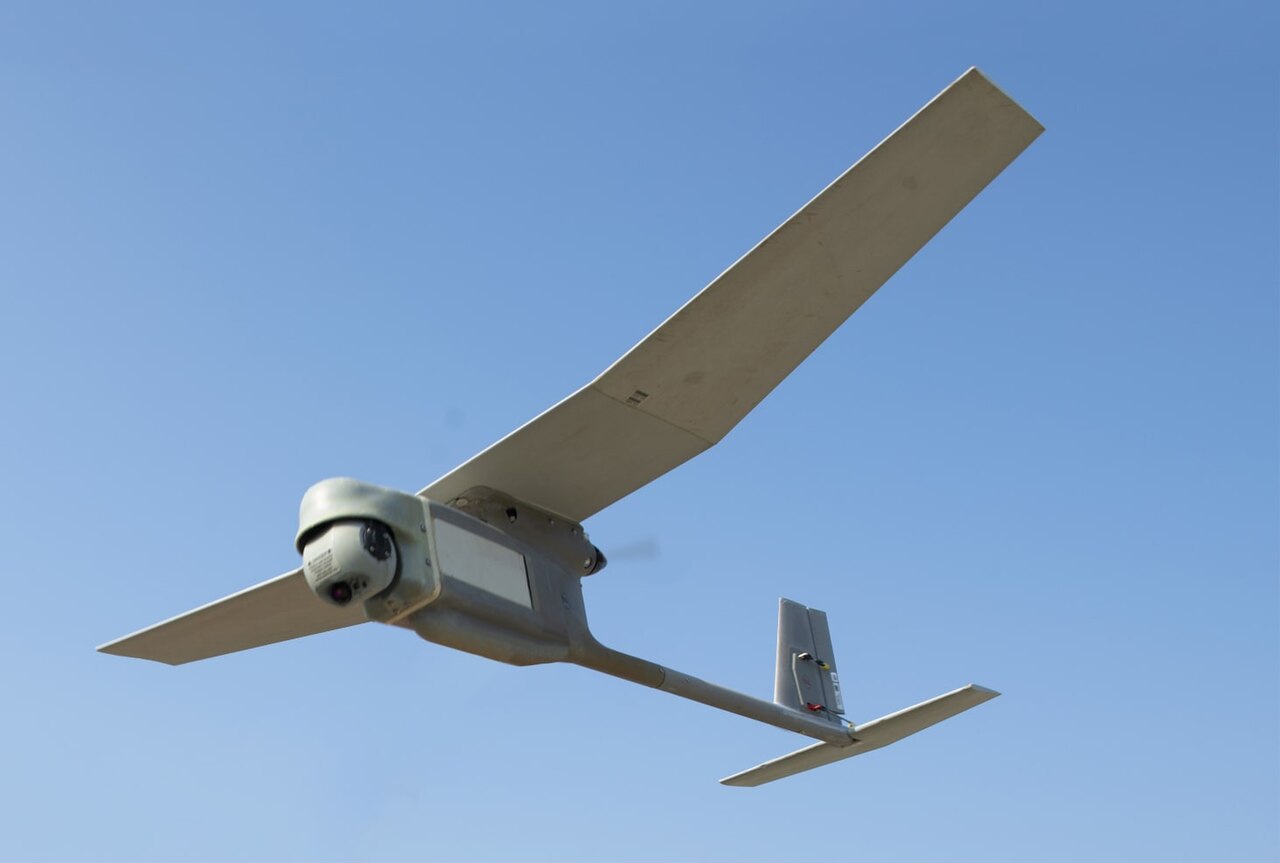
The Raven is thrown into the air by hand and lands itself in a deep stall, so it needs no runway or launcher at either end of a flight. AeroVironment's own documents call the aircraft the Raven B and do not carry the RQ-11 designation. Its two published sources also disagree about how long the Raven stays aloft.
What AeroVironment Publishes for the Raven B
AeroVironment publishes five headline figures for the Raven B across its datasheet and its product page.
The endurance figure depends on which AeroVironment source a reader opens. The datasheet's Distinctions block and the stat block on the Raven B product page both say 75+ minutes. Further down that same product page, a feature heading gives a range of 60 to 90 minutes, and its text says "up to around 90 minutes of flight time on a single battery."
A 75-minute floor and a 60-minute floor are different planning numbers for whoever schedules a flight. AeroVironment does not explain the gap on either source. A planner who needs one confirmed number can ask AeroVironment through the Raven B product page.
- Link range: 6.2 mi (10 km), on the datasheet and on the product page stat block, where it is labeled operational range
- Endurance: 75+ minutes on the datasheet and the product page stat block; 60 to 90 minutes in the product page feature section
- Aircraft weight: 4.8 lb (2.2 kg), on both sources
- Wingspan: 4.5 ft (1.4 m), on the datasheet
- Length: 3 ft (0.9 m), on the datasheet
Full Published Specification From the Raven Datasheet
The Raven datasheet, version 251030, lists speed, altitude, control, launch and recovery figures in addition to the five headline numbers. Dash speed is 81 kilometers per hour (44 knots), about two and a half times the cruise speed of 32 kilometers per hour (17 knots).
The datasheet gives speeds in kilometers per hour and knots only. It does not give a miles-per-hour figure.
| Specification | Published figure |
|---|---|
| Link range | 6.2 mi (10 km) |
| Endurance | 75+ min (datasheet Distinctions block) |
| Wingspan | 4.5 ft (1.4 m) |
| Length | 3 ft (0.9 m) |
| Weight | 4.8 lb (2.2 kg) |
| Cruise speed | 32 km/h (17 kts) |
| Dash speed | 81 km/h (44 kts) |
| Typical operating altitude | 100 to 500 ft (30 to 152 m) above ground level |
| Maximum launch altitude | 14,000 ft (4,267 m) above mean sea level |
| Ground control station | Tomahawk (standard); compatible with Crysalis and Legacy GCS |
| Launch method | Hand-launched |
| Recovery method | Autonomous or manual precision deep-stall landing |
| Payloads | Mantis i23 (dual 5 megapixel (MP) electro-optical and infrared (EO/IR) plus long-wave infrared (LWIR)); Mantis i23 D (dual 18 MP electro-optical (EO)); both field-swappable |
| Unit price | Not published by AeroVironment |
The Two Mantis Payloads
The Raven carries one of two camera payloads, the Mantis i23 or the Mantis i23 D, and AeroVironment describes both as field-swappable. A crew can change from one to the other in the field.
The Mantis i23 pairs dual 5 MP EO/IR sensors with an LWIR channel. The Mantis i23 D carries dual 18 MP EO sensors and lists no infrared channel.
The choice is a trade between image resolution and infrared. The i23 D gives the operator 18 MP electro-optical resolution, more than three times the i23's 5 MP figure, and gives up the infrared channels the i23 carries. A crew that needs the infrared channel picks the i23, and a crew that wants the higher electro-optical resolution picks the i23 D.
The Raven B product page describes a stabilized EO/IR payload delivering real-time imagery and geolocation data in day and night conditions. The datasheet lists intelligence, surveillance and reconnaissance (ISR) with real-time full-motion video among the Raven's listed features.
Hand Launch and Deep-Stall Recovery
The Raven needs no runway, launcher or recovery gear because it is thrown by hand at launch and lands itself in a deep stall at the end of a flight. The Raven B product page states that no runway or catapult is required and that small teams with minimal training can deploy the Raven.
For recovery, the product page says the Raven transitions into a deep stall descent and recovers autonomously without specialized gear. AeroVironment says this lets a crew retrieve the Raven in confined or uneven terrain without support infrastructure. The datasheet adds that the deep-stall landing can be flown autonomously or manually.
The datasheet describes the Raven as backpackable, at 4.8 pounds with a 4.5-foot wingspan. For how hand-launched airframes compare with other wing designs, see the overview of fixed-wing drones.
Where the RQ-11 Raven Sits in the Group 1 Class
AeroVironment classifies the Raven B as a lightweight Group 1 hand-launchable uncrewed aircraft system. The size classes are laid out on the site's guide to types of military drones.
The datasheet gives two altitude figures that measure different things. The typical operating band of 100 to 500 feet (30 to 152 meters) is height above ground level (AGL). The 14,000-foot (4,267-meter) figure is the highest launch altitude above mean sea level (MSL).
AeroVironment files the Raven B under both its Air and Land domains. The related solutions listed on the Raven B page are Puma 3 AE, Mayhem 10, VAPOR CLE, Puma VTOL, Puma LE and JUMP 20. The Puma 3 AE sibling airframe is covered on the AeroVironment Puma page.
The Ground Station Came From an Acquisition
The Raven's standard ground control station (GCS) carries the Tomahawk name, which AeroVironment acquired in 2023 with the company Tomahawk Robotics. The datasheet lists Tomahawk as the standard GCS and names Crysalis and Legacy GCS as compatible alternatives.
AeroVironment announced on 22 August 2023 that it would acquire 100% of Tomahawk Robotics equity for a total purchase price of $120 million in cash and stock. Brad Truesdell and Matt Summer founded Tomahawk Robotics in 2018. Tomahawk Robotics built the Kinesis Ecosystem, an AI-enhanced, open-architecture common control system that puts unmanned vehicles, sensors and third-party software on a single interface.
The same release pairs features of Crysalis, AeroVironment's own operating system, with Tomahawk Robotics' Kinesis platform. A reader looking at the GCS row of the Raven datasheet is therefore looking at the product of that acquisition: both the standard controller name and its compatible alternative appear together in the 2023 deal announcement.
Tomahawk Robotics joined the small unmanned aircraft systems (SUAS) business unit inside AeroVironment's Unmanned Systems segment. AeroVironment said it intended to keep the whole Tomahawk Robotics workforce and its Florida facilities. The release names Wahid Nawabi as AeroVironment's CEO and Chairman, and the Raven B product page describes the controller as portable and quick to learn.
The Raven on the 2025 FMS Contract
The Raven is one of five named systems on a five-year Indefinite Delivery, Indefinite Quantity (IDIQ) contract worth up to $874.26 million that AeroVironment received from the U.S. Army Contracting Command. AeroVironment announced the award on 8 December 2025.
The contract supports future foreign military sales (FMS) through Program Executive Office (PEO) Aviation. Allied and partner forces can use it to buy Group 1 to 3 unmanned aerial systems (UAS) and counter-UAS (C-UAS) systems. The systems on the contract are specific versions of the JUMP 20, P550, Puma, Raven and Titan C-UAS, plus training, initial spares packages and logistics support.
The $874.26 million figure is the ceiling of an IDIQ vehicle. It is neither an order placed nor revenue earned. The release publishes no order quantity, no per-aircraft figure and no delivery schedule, so dividing the ceiling by the five named systems gives no Raven price.
The release names Justin McFarlin as AeroVironment's Vice President of International Business Development. The sibling systems on the same contract are covered on the JUMP 20 and P550 pages.
What AeroVironment Does Not Publish About the RQ-11 Raven
AeroVironment publishes no unit price, system price or per-aircraft cost for the Raven on either the product page or the datasheet. The datasheet's own figures are also marked subject to change.
Several other figures are absent from both sources.
- Price: no unit, system or per-aircraft cost
- Operators: no operator list, country list or fielded-quantity figure
- Datalink: no frequency, encryption standard or bandwidth figure
- Battery: no battery model, capacity or recharge time
What to Check with AeroVironment Directly
AeroVironment also calls the Raven "the most widely deployed small unmanned aircraft system in the world." That is AeroVironment's own claim, and neither source publishes a count to support it. The Tomahawk Robotics release separately describes a network of more than 55 allied nations, without naming which of them fly the Raven.
Neither source mentions a successor or replacement aircraft. AeroVironment lists the Raven B as a current solution on its product page. The AeroVironment company profile covers AeroVironment's business and the filings to check. For a price, an operator list, datalink details or a confirmed endurance figure, contact AeroVironment through the Raven B product page.
Drones and UAS FAQs
What are the RQ-11 Raven's specs?
AeroVironment's Raven datasheet lists 6.2 mi (10 km) of link range, 75+ minutes of endurance, a 4.8 lb (2.2 kg) weight, a 4.5 ft (1.4 m) wingspan and a 3 ft (0.9 m) length. Cruise speed is 32 km/h (17 knots) and dash speed is 81 km/h (44 knots). AeroVironment's documents use the name Raven B.
How far can the RQ-11 Raven fly?
AeroVironment publishes a link range of 6.2 miles (10 kilometers) for the Raven. The Raven B product page labels the same figure operational range.
What is the RQ-11 Raven's wingspan?
The Raven datasheet gives a wingspan of 4.5 feet (1.4 meters) and a length of 3 feet (0.9 meters).
How long can the RQ-11 Raven stay in the air?
The answer depends on the AeroVironment source. The datasheet and the Raven B product page stat block say 75+ minutes. The feature section of the same product page says 60 to 90 minutes, and up to around 90 minutes on a single battery.
How much does an RQ-11 Raven cost?
AeroVironment publishes no unit or system price for the Raven. The $874.26 million 2025 contract that includes the Raven is an IDIQ ceiling covering five systems plus support, with no published per-aircraft figure.
How does the RQ-11 Raven land?
The Raven lands with a precision deep-stall descent that can be flown autonomously or manually. AeroVironment says this recovery needs no specialized gear and works in confined or uneven terrain.
How is the Raven launched?
The Raven is launched by hand. AeroVironment states that no runway or catapult is required.