MQ-25 Stingray: What the Navy's Carrier Tanker Drone Does
The T1 test asset has flown since 2019 and did all three of the 2021 refueling firsts. The first operational airframe has only taxied, and Boeing publishes no range, endurance, speed or unit-price figure for either.
What the MQ-25A Stingray Is and What It Does
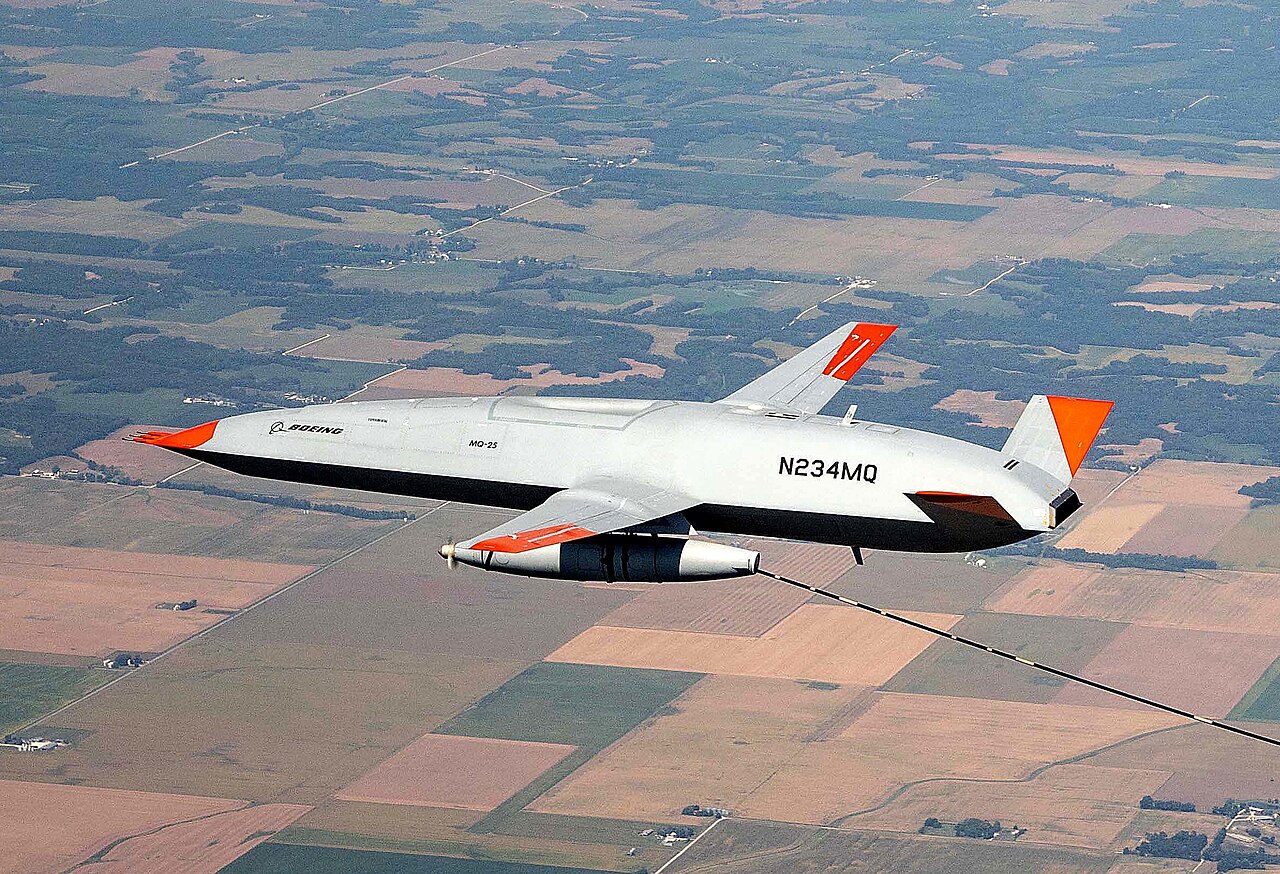
The MQ-25A Stingray is the U.S. Navy's first operational carrier-based unmanned aircraft, built primarily for unmanned aerial refueling and also equipped for intelligence, surveillance, and reconnaissance (ISR). It carries no published weapons role on Boeing's MQ-25 Stingray product page. Boeing assigns the aircraft aerial refueling and reconnaissance missions without naming any strike, ordnance, or combat munitions capability.
The airframe is a clean-sheet design informed by more than 90 years of carrier aircraft manufacturing experience across Boeing and its legacy companies. Unlike land-based combat platforms such as the armed MQ-9 Reaper, the aircraft operates directly from carrier flight decks to extend the reach of the fleet.
The airframe was purposely designed to accept new and changing technologies as missions evolve, including machine learning and artificial intelligence.
Autonomy and Manned-Unmanned Teaming Architecture
The MQ-25A Stingray is designed to taxi, take off, fly, and land autonomously at the push of a button. Air Vehicle Pilots command it through the Unmanned Carrier Aviation Mission Control System.
The MQ-25A is designed for manned-unmanned teaming, so it operates as an integrated flight partner with crewed aircraft. Sensors and secure, interoperable communications let it autonomously gather and relay information. Crewed aircraft can also direct the unmanned tanker mid-flight to perform complementary tasks such as aerial refueling, linking into concepts explored across broader collaborative combat aircraft architectures.
Operational Impact on the Carrier Air Wing
The primary mission of the MQ-25A Stingray is unmanned aerial refueling to extend the range, endurance, and operational flexibility of the carrier air wing. The MQ-25A removes fuel-transfer duties from front-line combat jets.
This dedicated aerial refueling role allows crewed fighters currently performing tanker duty to focus entirely on their primary mission of strike fighting. The MQ-25A is also equipped for ISR missions.
The T1 Test Asset and Refueling Milestones
The Boeing-owned T1 test asset validated the core refueling concept across a series of flight trials before production of military aircraft began. On September 19, 2019, Boeing and the U.S. Navy completed the first flight test of the MQ-25 T1 asset. T1 served as the predecessor to the four engineering development model aircraft ordered under the program's original manufacturing contract.
During 2021, the T1 test asset completed three historical aerial refueling demonstrations with distinct carrier airframes:
On December 20, 2021, the U.S. Navy and Boeing maneuvered the T1 test asset on an aircraft carrier flight deck for the first time. That deck-handling demonstration marked an early step toward integrating the refueler into carrier operations.
- June 7, 2021: The MQ-25 T1 test asset became the first unmanned aircraft in history to refuel another aircraft, safely transferring jet fuel to a U.S. Navy F/A-18 Super Hornet.
- August 19, 2021: The T1 asset successfully refueled a U.S. Navy E-2D Hawkeye command and control aircraft in flight.
- September 14, 2021: The T1 test aircraft transferred fuel in mid-air to a U.S. Navy F-35C Lightning II carrier-variant fighter.
Development Contracts and Operational Taxi Validation
The U.S. Navy awarded Boeing an $805 million engineering and manufacturing development contract on August 30, 2018, for the first four engineering development model (EDM) aircraft. On April 2, 2020, the Navy awarded a contract modification for three additional MQ-25A aircraft, bringing the total number of aircraft Boeing is manufacturing under the development effort to seven.
Boeing expanded its physical manufacturing infrastructure on September 17, 2021, announcing a new 300,000-square-foot (27,870.9-square-meter) production facility at MidAmerica St. Louis Airport in Mascoutah, Illinois. On March 11, 2025, Boeing moved the first U.S. Navy EDM aircraft into this facility to begin final assembly, making it the first airframe to start production at the MidAmerica St. Louis facility.
On January 29, 2026, the first operational MQ-25A Stingray completed its first taxi test. Air Vehicle Pilots in the Unmanned Carrier Aviation Mission Control System started the test at the push of a button. The aircraft taxied itself from the production facility to the MidAmerica St. Louis taxiway, then ran a series of maneuvers to validate its functionality.
Boeing confirmed this milestone moves the U.S. Navy's first MQ-25A closer to its first flight, establishing that the operational aircraft has not yet flown.
Airframe Dimensions and Carrier Deck Constraints
The MQ-25A Stingray is built to operate from aircraft carriers. The wings fold, taking the airframe from 75 feet across to 31.3 feet, because deck and hangar space on a carrier is allocated in feet and an aircraft that cannot shrink cannot be spotted alongside the air wing. Propulsion comes from a single Rolls-Royce AE 3007N engine.
Official dimensions published in Boeing's technical specifications define the overall size profile of the airframe:
| Airframe Dimension | Imperial Measurement | Metric Measurement |
|---|---|---|
| Wingspan (Wings Spread) | 75 feet | 22.9 meters |
| Wingspan (Wings Folded) | 31.3 feet | 9.5 meters |
| Length | 51 feet | 15.5 meters |
| Engine Type | 1 Rolls-Royce AE 3007N | 1 Rolls-Royce AE 3007N |
Published Boundaries and Unpublished Aircraft Specifications
Boeing's published documentation establishes clear limits on which figures are confirmed program data and which remain undisclosed. Boeing's specification table lists only the three dimensions and single engine type shown above. Boeing publishes no official figures for operational range, flight endurance, fuel-offload capacity, cruise speed, or service ceiling.
The published record contains no unit cost figures, and readers should not divide the initial $805 million development award by four to calculate an individual airframe price. The Navy has contracted seven development aircraft: the initial four EDM airframes, plus three more under the 2020 modification. Boeing's own product page publishes no total fleet procurement quantity.
The Navy production lot awarded in September 2026 and the program-of-record target appear in the Boeing vs Airbus comparison. Any later MQ-25A performance figure will appear on Boeing's MQ-25 Stingray product page before it appears anywhere else.
Public materials also make no mention of low-observable or stealth characteristics for the MQ-25A Stingray. Boeing does not describe the airframe as a stealth tanker, and official releases omit any claim regarding radar cross-section reduction. Boeing also omits operational squadron assignment dates and initial deployment timelines.
Industrial Team and Manufacturing Footprint
Boeing builds the MQ-25 Stingray inside its 300,000-square-foot facility at MidAmerica St. Louis Airport, drawing on a broad supplier network from the aerospace industrial base. Boeing calls the MQ-25A a clean-sheet design informed by more than 90 years of Boeing and legacy-company experience building carrier aircraft. Boeing is the prime contractor, and the MQ-25 appears in the wider inventory of US military drones.
Boeing's three dimensions and one engine type are the only MQ-25A figures with an official source, so check Boeing's MQ-25 Stingray product page before quoting any other number as a Boeing figure.
Drones and UAS FAQs
Can the MQ-25 carry weapons?
Boeing publishes no weapons role for the MQ-25A Stingray. Official program materials state the aircraft is built primarily for unmanned aerial refueling and equipped for intelligence, surveillance, and reconnaissance missions. Boeing does not list or assign any combat strike, missile, or bomb capabilities to the airframe.
Is the MQ-25 autonomous?
Yes, the MQ-25A is designed to taxi, take off, fly, and land autonomously at the push of a button. Air Vehicle Pilots command the aircraft remotely from the Unmanned Carrier Aviation Mission Control System. It also features manned-unmanned teaming capabilities, allowing it to autonomously gather and relay information and take mission directions from crewed aircraft.
Has the MQ-25 flown?
The Boeing-owned T1 test asset first flew on September 19, 2019, and completed aerial refueling trials with F/A-18, E-2D, and F-35C aircraft in 2021. However, the first operational MQ-25A aircraft has not yet flown. It completed its first autonomous taxi test on January 29, 2026, an event Boeing stated moves the operational aircraft closer to its first flight.
Is the MQ-25 stealth?
Boeing makes no stealth claim on its official MQ-25 product page. Boeing does not describe the aircraft as stealthy, nor does it publish radar cross-section data. Official specifications focus entirely on carrier compatibility, autonomous operation, dimensions, and the aerial refueling mission.
How many MQ-25 will be built?
Boeing is currently manufacturing seven aircraft under official development contracts. The U.S. Navy awarded an original contract for four engineering development model aircraft in 2018 and added three more via a contract modification in April 2020. Boeing's product page publishes no total program-of-record fleet buy quantity.
The Boeing vs Airbus comparison covers the Navy low-rate initial production lot awarded in September 2026 and the program-of-record target reported with it.
What engine does the MQ-25 use?
The MQ-25 Stingray is powered by a single Rolls-Royce AE 3007N engine.