HOVERAir X1 Pro vs ProMax: 4K Camera or 8K Flagship
Only the camera separates HOVERAir's two current X1 models, which makes this a narrower decision than two spec sheets side by side suggest.
The Sensor Is the Only Real Difference
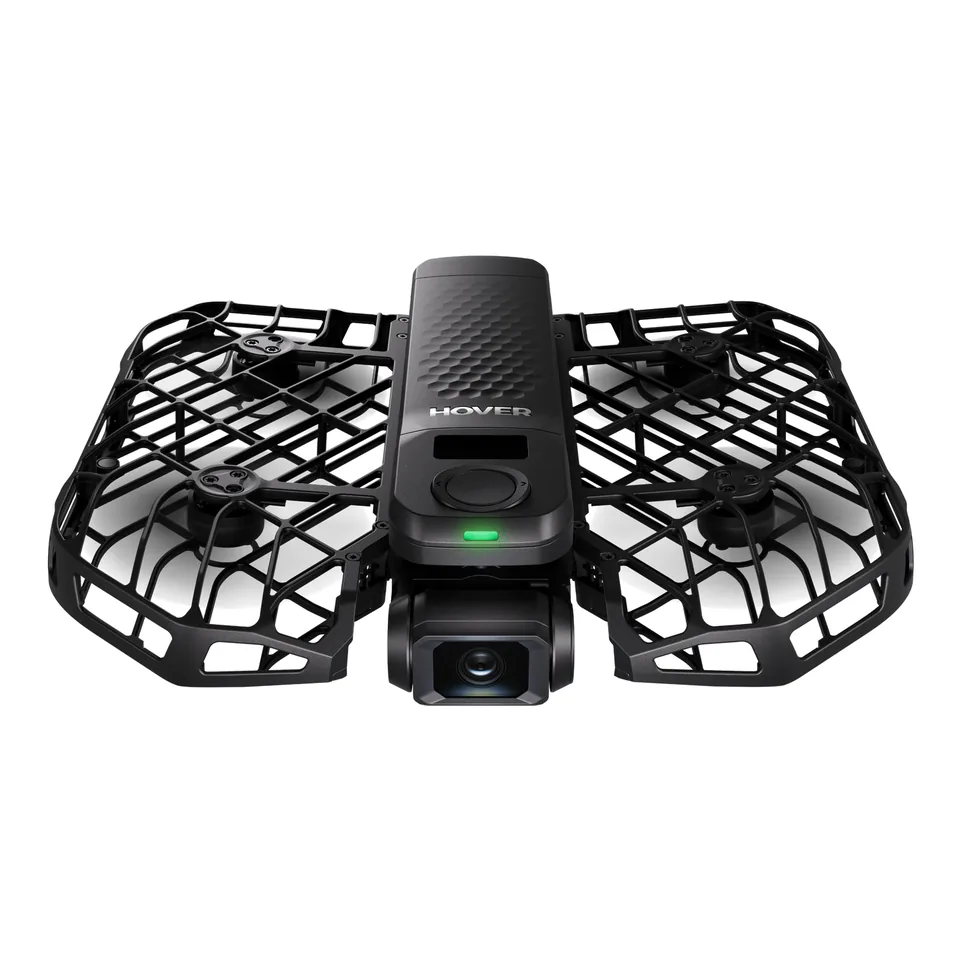
In the HOVERAir X1 Pro vs ProMax choice, the ProMax is the camera upgrade and the Pro is the 4K model.
At Drone and Defense, we cover the Pro on its own in our HOVERAir X1 Pro review. HOVERAir marks four specifications as "X1 PROMAX only": a 1/1.3-inch complementary metal-oxide-semiconductor (CMOS) sensor, an ultra-wide 107-degree lens, 8K video at 30 frames per second (fps), and 4K slow motion at 120fps. The X1 Pro records 4K and does not offer 8K.
Both models use the same 1920 milliamp-hour (mAh) battery, and HOVERAir sells one Charging Hub for X1 PRO and PROMAX. They also share the folding design, palm launch in under 3 seconds, tracking at up to 42 km/h, the 2-axis gimbal, the 15 flight modes and the whole accessory system.
That leaves the decision with one axis: 8K resolution and 120fps slow motion on one side, and the price gap between the two models on the other. HOVERAir's product page does not show a price for either model. Note both prices on the HOVERAir X1 Pro and ProMax product page before you weigh the four camera specifications against the difference.
What 8K and 4K at 120fps Change in Your Footage
The ProMax changes four things in the footage: 8K at 30fps against the Pro's 4K, a 4K slow-motion mode at 120fps, a 1/1.3-inch CMOS sensor, and an ultra-wide 107-degree lens. A clip recorded at 120fps and played back at 30fps runs four times slower, which is the arithmetic behind the 4K slow-motion mode.
Ask where your footage will end up before you pay for 8K. HOVERAir's own buying guidance for the Pro reads: "High cost-performance ratio, meets everyday family shooting needs, easily capturing warm moments in life." By HOVERAir's own description of the Pro as meeting "everyday family shooting needs", the 1/1.3-inch sensor, the 107-degree lens and the two ProMax-only video modes sit outside what that buyer needs.
HOVERAir positions the ProMax differently, calling it the "Flagship 8K Self-Flying" camera, "born for professional needs, supporting extreme sports". Both models track at up to 42 km/h (26 mph) for cycling, skiing or running, so a sports buyer gets the same follow speed from either one. The ProMax adds the 120fps mode for slowing down the fast moment it tracked.
Identical Hardware and a Shared Accessory System
Accessories bought for one model are not stranded by choosing the other, because HOVERAir sells its add-ons for both the X1 Pro and the X1 ProMax. If you later move from the Pro to the ProMax, the hub, case, controller pieces and filters move with you. The full list is below.
The flight hardware is shared too. Both models launch from your palm in under 3 seconds with no remote and no learning curve. Both carry artificial intelligence (AI) subject tracking, 15 built-in flight modes including Follow and Orbit, and HoverLink for high-precision tracking.
Stabilisation is identical: SmoothCapture 2.0 with a 2-axis gimbal and horizon levelling on both models. The 1920 mAh battery uses an intelligent battery management system (BMS) with overcharge, over-discharge, self-discharge and short-circuit protection on either aircraft.
HOVERAir's published specification for the X1 Pro rates it for wind resistance at Level 5, about 10.7 m/s. Our HOVERAir X1 Pro review describes Level 5 as roughly a fresh breeze. HOVERAir publishes no separate wind-resistance figure for the ProMax.
HOVERAir also states that the X1 Pro's propellers are fully enclosed in protective grids. HOVERAir publishes no separate propeller statement for the ProMax. If propeller guarding or wind tolerance decides your purchase, read the specification list on the HOVERAir X1 Pro and ProMax product page before you decide.
- Charging Hub for X1 PRO and PROMAX: charges two batteries in parallel, fills one battery in 45 minutes and two in 60 minutes, and shows battery level at the press of a button.
- Power Case: the equivalent of 12,000 mAh, adds 40 minutes of flight time, works at -20 C (-4 F), and lets the camera auto-sleep inside and redeploy with no wake-up time. Its extra USB-C port charges a phone, so it doubles as a power bank.
- Beacon and JoySticks: combine into a three-in-one remote controller for precise framing.
- HandleBar Mount and Mag Adapter bundle: for cycling, mounts the Beacon on the handlebars for a live preview.
- Neutral density (ND) filter set: ND8, ND16, ND32 and ND64, with a protective case.
- Repair Kit: replacement propellers and guards, plus a screwdriver, sold for the X1 PRO or PROMAX.
- HOVERCare: a protection plan HOVERAir offers alongside the hardware.
A Flight-Time Gap That Applies to Both Models
HOVERAir rates the shared 1920 mAh battery at up to 16 minutes of flight on both the X1 Pro and the X1 ProMax. The reviewers cited in our X1 Pro review report 11 to 13 minutes in real use for the Pro. No independent real-world flight time is published for the ProMax.
Plan around the reported number when you buy. One battery at 11 to 13 minutes is a short session, and two batteries at that rate give 22 to 26 minutes in the air. The Charging Hub fully charges both of those batteries in 60 minutes.
The Power Case is the bigger fix. HOVERAir says it adds 40 minutes of flight time and keeps working at -20 C (-4 F). Price a spare battery or the Power Case into either model from the start, because a single pack covers only one short flight.
Weight Figures That Differ by Source
The X1 Pro weighs 191.5 g according to HOVERAir's published X1 Pro specification, which our live X1 Pro review carries. HOVERAir's combined X1 Pro and ProMax page describes "a folding 192 gram design" and does not break that figure out by model. HOVERAir publishes no separate ProMax weight.
Weight decides registration for recreational fliers. At 191.5 g, the X1 Pro sits under the Federal Aviation Administration (FAA) 250 g registration threshold for recreational flight. The shared 192 g figure is also under 250 g, but because HOVERAir does not assign it to a specific model, it does not settle the ProMax's own weight.
If registration status matters to your decision, confirm the ProMax weight on the HOVERAir X1 Pro and ProMax product page before you buy.
HOVERAir X1 Pro vs ProMax Side by Side
Four of the eleven rows below differ between the models, and all four are camera specifications that HOVERAir labels ProMax only. Battery, tracking, stabilisation and flight modes are identical on both, so those rows give you no reason to pick one model over the other.
The price row reads not published for both because HOVERAir's product page does not display either price.
| Dimension | X1 Pro | X1 ProMax | What it means in practice |
|---|---|---|---|
| Video resolution | 4K | 8K at 30fps | A real difference. The ProMax records at a higher resolution than the Pro. |
| Slow motion | Not published for the Pro | 4K at 120fps | A real difference. Only the ProMax lists a 120fps slow-motion mode. |
| Sensor | Not separately published | 1/1.3-inch CMOS | A real difference. HOVERAir marks this sensor as ProMax only. |
| Lens field of view | Not separately published | Ultra-wide 107 degrees | A real difference. HOVERAir marks the 107-degree lens as ProMax only. |
| Weight | 191.5 g (HOVERAir published spec) | Not separately published; HOVERAir's shared page says "folding 192 gram design" for both | Varies by source. The Pro's 191.5 g sits under the FAA 250 g recreational threshold; no separate ProMax figure is published. |
| Battery | 1920 mAh, rated 16 min (shared) | 1920 mAh, rated 16 min (shared) | Identical. The reviewers cited in our X1 Pro review report 11 to 13 minutes for the Pro. |
| Tracking speed | Up to 42 km/h (shared) | Up to 42 km/h (shared) | Identical. Both follow cycling, skiing or running at the same rated speed. |
| Stabilisation | SmoothCapture 2.0, 2-axis gimbal (shared) | Same | Identical, including horizon levelling. |
| Flight modes | 15 built in (shared) | Same | Identical, including Follow and Orbit. |
| Wind resistance | Level 5, about 10.7 m/s (HOVERAir published spec) | Not separately published | Published for the Pro only. The only published wind limit covers the Pro; HOVERAir publishes no separate ProMax figure. |
| Price | Not published | Not published | Not published; the gap is what the four camera rows cost you. |
Who Each Model Suits in the HOVERAir X1 Pro vs ProMax Decision
Neither model wins by default, because the right pick depends on whether you will use the four ProMax-only camera specifications. HOVERAir's own two positioning statements line up with that split. The Pro is described for "everyday family shooting needs", and the ProMax is described as "born for professional needs, supporting extreme sports".
The Pro stops being the right buy once you want slow motion, since 4K at 120fps is listed only for the ProMax. The ProMax stops being the right buy when you have no use for slow motion, 8K or the 107-degree lens. In that case you pay the price gap for a sensor and modes you will not use.
- Pick the X1 Pro for family and everyday clips delivered at 4K, with a published 191.5 g weight under the FAA 250 g recreational threshold.
- Pick the X1 ProMax if you edit your footage and want 4K at 120fps slow motion, 8K at 30fps and the ultra-wide 107-degree lens.
- Skip both if your decision rests on obstacle avoidance, a waterproof or IP rating, or a range figure. None of these is published for either model.
What Would Change Our Pick
The price gap is the first thing that would move this verdict. If HOVERAir prices the ProMax close to the Pro, the ProMax becomes the easier pick for most buyers, because the four camera upgrades come at little extra cost. A wide gap pushes the everyday family buyer firmly toward the Pro.
A published ProMax weight would also matter. A ProMax figure at or above 250 g would change its FAA recreational registration status, while a figure in line with HOVERAir's 192 g description would leave the two models level on weight.
An independent real-world flight time for the ProMax would show whether it shares the Pro's 11 to 13 minutes. Until then, open the HOVERAir X1 Pro and ProMax product page, note both prices, and set the gap against the four ProMax-only specifications to settle the HOVERAir X1 Pro vs ProMax choice.
Drones and UAS FAQs
What is the difference between the HOVERAir X1 Pro and the X1 ProMax?
The ProMax adds four camera specifications that HOVERAir marks as ProMax only: a 1/1.3-inch CMOS sensor, an ultra-wide 107-degree lens, 8K video at 30fps and 4K slow motion at 120fps. The X1 Pro records 4K. Battery, tracking speed, gimbal, flight modes and accessories are the same on both.
Is the HOVERAir X1 ProMax worth it over the X1 Pro?
It is worth it if you edit footage and will use the 120fps slow motion, the 8K mode or the 107-degree lens. For everyday family clips, which is how HOVERAir itself describes the Pro, those upgrades go unused. HOVERAir's product page does not show prices, so compare the gap on the HOVERAir X1 Pro and ProMax product page before deciding.
Does the HOVERAir X1 ProMax shoot 8K?
Yes. HOVERAir lists 8K video at 30fps as an X1 ProMax-only feature, along with 4K slow motion at 120fps. The X1 Pro records 4K and does not offer 8K.
Do the X1 Pro and X1 ProMax use the same batteries and accessories?
Yes. Both use the same 1920 mAh battery, and HOVERAir sells its Charging Hub, Power Case, Beacon and JoySticks, ND filter set and Repair Kit for both models. Accessories bought for one model work with the other.
How much do the HOVERAir X1 Pro and ProMax cost?
HOVERAir's product page does not show a price for either model. Check current prices for each model on the HOVERAir X1 Pro and ProMax product page. The gap between the two is the cost of the ProMax's sensor, lens, 8K mode and 120fps slow motion.