XLUUV Comparison of Boeing Orca and Anduril Ghost Shark
Boeing's diesel-electric Orca is the US Navy's extra-large uncrewed undersea vehicle (XLUUV), and Boeing says the first operational Orca was delivered in September 2025. Naval News reports the Navy plans to buy two Orcas in fiscal year (FY) 2027 for $135.8 million.
Anduril's Ghost Shark entered Royal Australian Navy service in April 2026 under a contract worth A$1.7 billion, Army Recognition reports. The US Navy and the Defense Innovation Unit picked Anduril's Dive-XL for a prototype project in March 2026, Defense News reported.
XLUUVs Compared: Orca, Ghost Shark, Dive-XL and Others
The table lists seven named vehicles described as extra-large uncrewed undersea vehicles, and two of them, Boeing's Orca and Anduril's Ghost Shark, have been delivered to a navy as operational vehicles. Boeing's 2025 Annual Report says Orca XLE1, the first operational vehicle, was delivered in September 2025.
Army Recognition reports that the Royal Australian Navy (RAN) brought Ghost Shark into operational service on April 14, 2026.
Boeing lists Orca's length, width, range, payload weight and propulsion. No official Ghost Shark specifications have been published, according to Army Recognition, Breaking Defense and Naval News. Anduril publishes Dive-XL figures, and Breaking Defense calls Dive-XL "Ghost Shark's commercial baseline vehicle," but no source says those figures carry over to the Australian vehicle.
| Vehicle | Builder | Operator or customer | Status (latest source) | Published size or propulsion | Source |
|---|---|---|---|---|---|
| Boeing Orca | Boeing, with Huntington Ingalls Industries | US Navy | XLE1 delivered September 2025; XLE2 commissioned in 2026; 1,000 nautical mile Pacific transit in July 2026 | 51 ft (16 m) long and 8.5 ft (2.6 m) across, 85 ft (26 m) with payload section; hybrid diesel-electric | Boeing 2025 Annual Report; Boeing XLUUV page; Naval News (August 2026) |
| Anduril Ghost Shark | Anduril Australia | Royal Australian Navy | In operational service since April 14, 2026; at Maritime Big Play exercises in October 2026 | No official specifications published | Army Recognition (April 2026); ABC News (October 2026) |
| Anduril Dive-XL | Anduril | US Navy and Defense Innovation Unit (CAMP project) | Selected for CAMP in March 2026; contract value undisclosed | Range over 2,000 nmi; payload volume about 11.4 cubic meters; all-electric; fits a 40-ft shipping container | Anduril Dive-XL page; Defense News (March 2026) |
| XV Excalibur | MSubs | Royal Navy | Demonstrator; fired an exercise Mk 48 torpedo on September 13, 2026 | 12 m long, 2 m across, 19 tonnes; propulsion unpublished | UK Defence Journal (May 2025 and September 2026) |
| BAE Systems Herne | BAE Systems, with Cellula Robotics | No customer named in sources | In-water UK demonstration in 2024 | 12 m long, 8 to 10 tonnes; lithium-ion batteries; 3,000 m depth rating | UK Defence Journal (November 2024); BAE Systems product page |
| HSU100 | Not published | China | Displayed at the September 3, 2025 Beijing parade | About 15 m long (analyst estimate) | Asian Military Review (September 2025) |
| AJX002 | Not published | China | Displayed at the September 3, 2025 Beijing parade | About 18 to 20 m long, 1 to 1.5 m diameter (analyst estimate) | Naval News, H I Sutton (August 2025); Asian Military Review |
Orca vs Ghost Shark Head to Head
Orca is a US Navy research and development effort with a counted fleet, while Ghost Shark is an Australian program of record buying an uncounted fleet described as "dozens." Boeing says it is fabricating the remaining vehicles "for a total of five operational vehicles," after the XLE0 test asset delivered in December 2023.
The Australian Government has not published a Ghost Shark fleet number, and ABC News reports Defence has not revealed the total.
The published money differs in kind. The Australian Minister for Defence's September 2025 release says the government is investing A$1.7 billion to acquire the Ghost Shark fleet, with a five-year contract covering delivery, maintenance and continued development. Breaking Defense converts that to 1.1 billion US dollars.
For Orca, Breaking Defense reports about $885 million in development spending over eight years, and Naval News reports $1.13 billion planned for XLUUVs across the Navy's FY2027 to FY2031 Future Years Defense Program (FYDP).
Each program has a different headline demonstration on record. Naval News reports that Orca completed a 1,000 nautical mile transit across the East Pacific in July 2026, a first for the US Navy. ABC News reports that Ghost Sharks took part in Maritime Big Play exercises with the US and UK off Southern California in October 2026.
The two programs also differ on schedule. Naval News quoted Minister for Defence Industry Pat Conroy saying all three Ghost Shark prototypes were delivered "on budget and ahead of schedule." Army Recognition says the first prototype arrived in April 2024, a year early.
The Government Accountability Office (GAO) found in 2022 that Orca was at least $242 million, or 64 percent, over its original cost estimate and at least three years late.
What Makes a UUV Extra-Large
The US Navy defines an XLUUV as an uncrewed undersea vehicle (UUV) more than 84 inches in diameter, according to the Congressional Research Service (CRS). CRS report R45757 explains the line: Navy submarines with large-diameter vertical launch tubes can launch payloads of up to about 83 inches, so an XLUUV is too large to launch from a crewed submarine. CRS says XLUUVs are "roughly the size of a subway car."
Because an XLUUV cannot ride a submarine, CRS says it is to be transported to a forward operating port and launched from a pier. Boeing says Orca launches and recovers pier-side without a dedicated support vessel. Anduril says Dive-XL has a two-point lift interface for launch from ships or piers and fits in a standard 40-foot shipping container.
Published widths show which vehicles clear the Navy's 84-inch line. Boeing gives Orca as 8.5 feet across, which is 102 inches (8.5 × 12) and clears the 84-inch threshold. UK Defence Journal gives Excalibur as 2 metres across, about 79 inches, which sits under the US Navy figure even though UK Defence Journal calls it an XLUUV.
Australian Defence has described these vessels by length. Australian Defence quoted Rear Admiral Peter Quinn in 2022 describing these vessels as "typically between 10 and 30 metres long." Army Recognition notes that this 10 to 30 metre range describes the class, and has not been confirmed for Ghost Shark itself.
Boeing Orca XLUUV Program History and Status
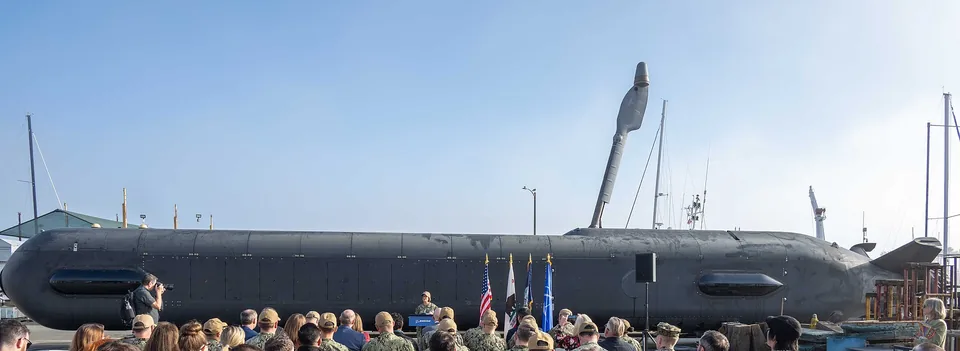
The Orca XLUUV program began in 2017 to meet an emergent operational need, according to Boeing, and CRS says it addressed a Joint Emergent Operational Need (JEON). Boeing says it started designing its Echo Voyager proof-of-concept vehicle in 2012 and took it to sea in 2017. The War Zone reports that the Navy awarded XLUUV development contracts to Boeing and Lockheed Martin in 2017.
CRS says the Navy picked Boeing on February 13, 2019, to build the first four Orcas, over a team led by Lockheed Martin. CRS says the award grew to a fifth Orca on March 27, 2019. The War Zone puts the February 2019 award to Boeing and Huntington Ingalls Industries (HII) at $43 million for four vehicles.
CRS says Boeing builds Orca with HII's Technical Solutions division and that the first five vehicles were funded in FY2019 from research and development accounts.
The GAO's 2022 audit found the contractor planned to deliver the first vehicle by December 2020 and all five by the end of 2022. GAO said differences from Echo Voyager forced a redesign of critical components. No production readiness review was held, GAO found, and COVID-19 worsened the delays.
GAO's product page says both of its recommendations were still open as of August 2025, with the Navy planning readiness reviews and a full cost estimate in FY2026.
The Naval Sea Systems Command (NAVSEA), in a release reprinted by Seapower, said the Navy accepted the XLE0 test asset in December 2023 after in-water testing began in spring 2023.
Breaking Defense reported in June 2025 that GAO called it "unclear" whether Orca would become a program of record. Naval News later reported two Orcas planned for FY2027 and 14 more across the FYDP, and Naval News reported XLE2 was commissioned in 2026.
Anduril Ghost Shark and Dive-XL
Breaking Defense calls Dive-XL Ghost Shark's commercial baseline vehicle, and Naval News reports the Ghost Shark contract builds on about $140 million invested since a 2022 collaborative contract. Australian Defence said in 2022 that Anduril and the Defence Science and Technology Group would produce three prototypes.
Breaking Defense reported in November 2025 that the first production Ghost Shark rolled off the Sydney line, and ABC News reports the first was delivered in January 2026.
Dive-XL is Anduril's own extra-large vehicle, and Anduril says its core is free-flooded and built from aluminum and fiberglass with commercial off-the-shelf pressure vessels. Anduril's Dive-XL page lists a maximum range of more than 2,000 nautical miles and an all-electric powertrain that runs missions without surfacing. Anduril said in December 2024 that Dive-XL had completed a 100-hour single voyage.
The Defense Innovation Unit (DIU) and the US Navy selected Anduril for the Combat Autonomous Maritime Platform (CAMP) project, Defense News reported on March 12, 2026. The Defense Post reports DIU targets of more than 1,000 nautical miles of travel and dives deeper than 200 meters. Those figures are CAMP requirements. They do not describe Dive-XL, whose depth rating Anduril has not published.
Defense News says Anduril will run an extended Dive-XL demonstration within four months of contract award.
Dive-XL also sits in a UK and US effort. Defense News reports the US and Royal Navy are pursuing a follow-on acceleration with Project CUTLASS, which will use Dive-XL. Anduril's wider undersea line, including Dive-LD, is covered on the Anduril underwater drones page.
What Each Extra-Large Vehicle Carries
Boeing's XLUUV page says Orca's 34-foot payload module carries up to 8 tons dry. Boeing equates that to nine medium UUVs of 21-inch diameter or 48 small UUVs of 12.8-inch diameter. CRS says the Navy testified in March 2021 that mines would be the initial XLUUV payload.
CRS adds that the Navy wants XLUUVs to covertly deploy the planned Hammerhead mine, tethered to the seabed and armed with an antisubmarine torpedo.
Naval News reports Orca will deploy with Hunter, an expeditionary mining payload, and with a standoff heavyweight torpedo deployment system preparing to move to program office PMS 406. Breaking Defense reported officials' statement that changing Orca payloads would require the Navy to pay Boeing to modify proprietary software.
ABC News reports that Ghost Shark can carry up to 12 sea mines at once and launch Anduril Altius aerial drones, which ABC says carry four kilograms of explosives. ABC adds that the modular design allows torpedo, reconnaissance and special forces supply fits. Anduril says Dive-XL carries up to three payload modules or one extra-large module, with payloads such as Copperhead and Seabed Sentry.
For the European vehicles, UK Defence Journal reports Herne has two 2,500-litre payload bays that combine into one 5,000-litre bay. Defense News says Excalibur has no torpedo tubes and a large central payload bay, and IBTimes UK reports the Mk 48 was carried externally beneath the hull.
Other XLUUV Programs
The Royal Navy's XV Excalibur, built by MSubs, was unveiled at HMNB Devonport on May 15, 2025, according to UK Defence Journal. The outlet says Excalibur came out of the three-year Project CETUS and is a demonstrator that will not carry out operational duties.
Defense News reports Excalibur fired a Mk 48 torpedo on September 13, 2026, at the British Underwater Test and Evaluation Centre in Scotland.
Sources disagree on the torpedo variant fired from Excalibur. Defense News names the Mk 48 MOD 7, IBTimes UK says an inert, recoverable Mk 48 Mod 4, and UK Defence Journal says an exercise US Mk 48. UK Defence Journal reports the trial ran under Project Broadsword and Trial Iron as part of AUKUS Pillar 2.
BAE Systems' Herne, built with Canada's Cellula Robotics, is rated to 3,000 metres and runs 7 to 10 days on lithium-ion batteries, per UK Defence Journal. UK Defence Journal adds that hydrogen fuel cells are planned for up to 45 days or 5,000 kilometres. BAE says Herne is set to become the first XLAUV certified to the Unmanned Marine Systems Code, with Lloyd's Register as assurer.
China's navy has the largest XLUUV program of any navy, with at least five types in the water for several years, according to H I Sutton writing in Naval News. Sutton judged it "almost certain" that the vehicles seen in testing are not nuclear-powered. Smaller classes are covered on the unmanned underwater vehicles page.
Specifications and Figures Not Published
Orca lacks an official depth rating, top speed, vehicle weight and per-vehicle unit cost in any source on record. The War Zone gives a cruising speed of about three knots and a core weight of 80 tons, but Boeing publishes neither figure. No source reports whether any Orca has made an operational deployment.
Ghost Shark has no published length, diameter, displacement, range, depth, speed, endurance or propulsion figures, and no exact fleet count or unit cost. Dive-XL's length, diameter, weight, depth rating and speed are unpublished, and The Defense Post reports the CAMP contract value was not disclosed.
Anduril set a goal of a 1,000 nautical mile fully submerged mission in the first half of 2025, and no source confirms whether it was completed.
Excalibur's depth rating, propulsion, range and endurance are unpublished, as are the start date, budget and schedule of Project CUTLASS. The roles of China's HSU100 and AJX002 rest on analyst judgment, since no official designations or missions have been released. For the Orca program's open audit items, read the GAO-22-105974 product page, which tracks the Navy's planned production readiness reviews and cost estimate.
Maritime Unmanned Systems FAQs
What is the Orca submarine?
Orca is Boeing's extra-large uncrewed undersea vehicle for the US Navy, which NAVSEA describes as an autonomous, unmanned diesel-electric submarine with a modular payload section. Boeing's 2025 Annual Report says it is 51 feet long and 8.5 feet across, or 85 feet with its 34-foot payload section. Boeing's product page instead gives 51 feet overall.
Boeing gives its range as up to 6,500 nautical miles, and GAO says the Navy is pursuing XLUUVs to lay undersea mines.
What is the weight of the Orca XLUUV?
Boeing does not publish a vehicle weight for Orca. The War Zone describes the core vehicle as 80 tons, and that figure appears in no Boeing or Navy source on record. Boeing publishes only the payload capacity: up to 8 tons dry in the 34-foot payload section.
What countries have underwater drones?
The United States, Australia, the United Kingdom and China all have named extra-large underwater drone programs in the published record. The US Navy has taken delivery of Boeing's Orca, Australia's navy operates Anduril's Ghost Shark, and the Royal Navy tests the MSubs-built Excalibur.
Naval News analyst H I Sutton says China has at least five XLUUV types in the water, and the military underwater drones page covers more.
Does the USA have underwater drones?
Yes, the US Navy accepted Boeing's Orca XLE0 test asset in December 2023 and the first operational Orca, XLE1, in September 2025, per Boeing. Naval News reports XLE2 was commissioned in 2026 and that Orca completed a 1,000 nautical mile Pacific transit in July 2026. The Navy and DIU also selected Anduril's Dive-XL for the CAMP prototype project in March 2026.
Has the Orca XLUUV been cancelled?
No source on record reports that the Orca XLUUV has been cancelled. Breaking Defense reported in June 2025 that GAO called its transition to a program of record "unclear." Naval News then reported in May 2026 that the Navy plans to buy two Orcas in FY2027 for $135.8 million, and in August 2026 that Orca completed a 1,000 nautical mile transit.
What is the largest unmanned submarine in the world?
No single answer can be confirmed, because several XLUUV programs do not publish their sizes. Boeing calls Orca the largest UUV, and its 2025 Annual Report gives a total length of 85 feet (26 meters) with the payload section. Boeing's product page lists 51 feet (15.5 meters) overall.
Naval News analyst H I Sutton estimates China's AJX002 at 18 to 20 meters, and Ghost Shark's dimensions are unpublished.
Primary sources
- Congressional Research Service: Navy Large Unmanned Surface and Undersea Vehicles (R45757)
- GAO: Extra Large Unmanned Undersea Vehicle (GAO-22-105974)
- Boeing: XLUUV product page
- The Boeing Company: 2025 Annual Report
- Naval News: U.S. Navy Orca XLUUV Completes 1,000-Mile Pacific Transit
- Australian Minister for Defence: Equipping the Royal Australian Navy with next generation autonomous undersea vehicles
- Defense News: US Navy partners with Anduril to develop XL underwater vessel
- Army Recognition: Australian Navy Fields Ghost Shark XL-AUV as New Maritime Autonomous Unit Enters Service