Kord Firefly Laser: KBR's Pilot-Selected Counter-Drone Weapon
The Kord Firefly laser is a palletized counter-drone laser that KBR lists in two versions, 10 kilowatts (kW) and 20 kW, in its Firefly datasheet.
Press reports cite wider spans of 5 to 30 kW and 5 to 40 kW, which may describe the scalable laser architecture the datasheet mentions. The datasheet itself sells only the two options.
The Pentagon's Joint Interagency Task Force 401 (JIATF-401) named Firefly one of four systems for a one-year base-defense pilot, according to Defense News. It published no quantity, base assignment or price. Firefly is built by Kord Technologies, a KBR subsidiary.
The datasheet-versus-press comparison below is a reading of published text from five outlets, and no independent test of the system was run.
Firefly Specs Differ Between the Datasheet and Press Reports
KBR's datasheet lists two Firefly power options, 10 kW and 20 kW, and every other power figure in circulation comes from press reports. The datasheet says Firefly is "based on KORD's scalable high-energy laser architecture and is available in 10kW or 20kW options."
The Huntsville Business Journal reported power "scalable from 5 kW to 40 kW," and Defense News attributed the same 5 to 40 kW range to Kord's marketing. Air & Space Forces Magazine gave a third figure, 5 to 30 kW.
For sizing Firefly, cite 10 or 20 kW as the KBR specification and treat 5 to 40 kW as a marketing range for the architecture. The table sets the datasheet beside the press figures on each disputed item.
| Item | KBR-Kord datasheet | Press reports | Why they may differ |
|---|---|---|---|
| Power | 10 kW or 20 kW | 5 to 40 kW (Huntsville Business Journal; Kord marketing per Defense News); 5 to 30 kW (Air & Space Forces Magazine) | The datasheet sells two options of a scalable architecture. The press ranges may describe that architecture |
| Runtime | ">30mins" magazine depth in the features list; ">40mins" in the specification table | "About 15 hours" of battery life (Huntsville Business Journal) | The datasheet disagrees with itself, and magazine depth and battery life may measure different things |
| Engagement range | Not published | Engages at one mile in a quote from Jon Shepard; roughly 1.5 miles in the same article's spec list | One article gives two figures. The datasheet gives none |
| Tracking range | Not published | Up to five miles (Shepard, Huntsville Business Journal) | Only one source gives a figure |
| Time to defeat a drone | Not published | About 2 to 5 seconds (Huntsville Business Journal); "just a few seconds" for a small drone (Defense News) | The datasheet gives no engagement time |
| Operating temperature | Minus 20 to 50 degrees Celsius | Minus 15 to 35 degrees Celsius (Defense News) | Not explained in the cited reports |
| Size and weight | 50.1 x 49.7 x 77.9 inches; under 1,500 lb | Not given | Only the datasheet publishes dimensions |
What Firefly Is and How an Operator Uses It
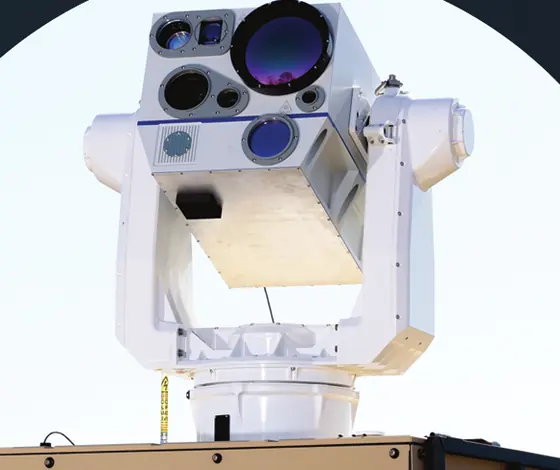
Firefly is described in its datasheet as "a next-generation, self-contained, palletized high-energy laser system." The pallet carries its own power supply, thermal management, high-capacity batteries, and integrated radar and electronic warfare subsystems.
Artificial intelligence (AI) detection and tracking algorithms "detect, track, intercept and defeat incoming UAS threats at standoff ranges," with UAS meaning unmanned aircraft systems. Its visible, short-wave infrared (SWIR) and mid-wave infrared (MWIR) cameras, high-power target illuminator and eye-safe laser range finder feed the tracking software, and a Ka-band radar is available.
Firefly connects to the Forward Area Air Defense (FAAD) and MEDUSA command-and-control systems.
The Huntsville Business Journal reported that Firefly was designed, engineered and tested in Huntsville and shoots from a truck bed or flatbed. Jon Shepard, KBR's director of directed energy technology programs, said it becomes operational within 30 minutes and that one soldier got it running in five minutes.
The article says it works with Sentinel Radar and FAAD command and control. The article also reported that batteries recharge from off-the-shelf generators.
A person still decides "not just when to fire, but also where to fire," according to Defense News. An Xbox controller is part of the operator interface, and David Zoller, KBR senior director, said it shortens training.
At an August live demonstration in north Alabama, attendees wore laser-protection goggles, according to WAFF. Zoller called Firefly "a homegrown product."
The datasheet publishes no engagement range, no engagement time and no price. Its listed uses are military bases, convoys, airports, protection of very important persons (VIPs), outdoor venues, high-value targets and key infrastructure.
What the Pentagon Pilot Selected
The Pentagon selected Firefly as one of four directed-energy weapons for a homeland counter-drone pilot run by JIATF-401, an Army-led task force set up the previous year. Congress required the pilot in the 2026 National Defense Authorization Act (NDAA), according to Air & Space Forces Magazine.
JIATF-401 chose five installations in May, according to Inside Unmanned Systems: Fort Huachuca, Arizona; Fort Bliss, Texas; Naval Base Kitsap, Washington; Grand Forks Air Force Base, North Dakota; and Whiteman Air Force Base, Missouri. An earlier demonstration at White Sands Missile Range validated that the directed-energy systems pose no undue risk to passenger aircraft.
The pilot is set to run one year, with service members to operate and maintain the weapons and collect data while the Pentagon gathers cost and logistics information. Defense News reported that deployment plans with installation commanders take 180 days and that operations are expected later this year. The pilot is coordinated with the services, U.S. Northern Command and the Federal Aviation Administration (FAA). No start date was given.
A shoot-off for more laser and microwave systems is set for December at Dugway Proving Ground, Utah. Brig. Gen. Matt Ross said systems that perform well could "immediately result in a purchase order." Four pilot details were not disclosed in the Oct. 6 Defense News report:
- Which system goes to which installation
- How many of each system will be fielded
- The cost of the systems
- The cost of the pilot
What the Pilot Means for Firefly Revenue
The JIATF-401 pilot is an assessment, and by itself it gives no evidence of KBR revenue from Firefly. No contract value, quantity or purchase order tied to Firefly appears in any cited report.
Ross has questioned judging these weapons by cost per shot alone. In August he said, "If I procure that system and it costs me $6 million and I take one shot a year..." He also said lasers and microwaves "are tools that can be effectively used in a layered drone defense."
Where Firefly Sits Among the Four Pilot Systems
Firefly is one of three lasers in the pilot, alongside systems from AeroVironment and Boeing, while Epirus supplies the only microwave. The table lists only figures published in the cited reports.
For Army laser context, see the Army E-HEL laser explainer. The anti-drone microwave guide covers the Leonidas approach, and the anti-drone lasers page covers laser systems across programs.
| System | Type | Power figure in cited reports | Other published detail |
|---|---|---|---|
| Kord Firefly | Laser | 10 kW or 20 kW (datasheet); 5 to 40 kW (Kord marketing); 5 to 30 kW (Air & Space Forces Magazine) | Palletized, battery powered |
| AeroVironment Palletized High-Energy Laser | Laser | Not published in the cited reports for the pilot | LOCUST laser on a roll-on, roll-off pallet. The Army separately awarded a 30 kW LOCUST X3 contract, and the pilot source is unconfirmed |
| Epirus Leonidas | High-powered microwave | Not published in the cited reports | Only microwave in the pilot |
| Boeing Compact Laser Weapon System | Laser | 2 kW and 5 kW versions | A 5 kW version defeated Group 3 drones in a 2024 demonstration |
Who Owns Firefly and What to Check
Firefly comes from Kord Technologies, "a wholly owned subsidiary of KBR," according to a March 25, 2025 release filed with the Securities and Exchange Commission (SEC). In that release, Applied Energetics and Kord announced a collaboration on advanced pulsed laser development for Firefly, and it named Shepard as Firefly Program Technical Manager.
Zoller told the Huntsville Business Journal that KBR has worked in directed energy for over a decade. None of the cited reports names a Firefly customer, a production volume or a contract.
These reports give no performance results, price per shot or stock view, and no pilot results appear in them. Read the Firefly datasheet for the specification, and use the KBR investor site for company stock information and disclosures.
Three developments would change this read:
- A JIATF-401 purchase order for Firefly after the December Dugway shoot-off
- A revised Firefly datasheet replacing the 2023 power options or adding a range
- A KBR disclosure on the investor site naming a Firefly contract, customer or quantity
Limits to Know
Firefly can engage only one threat at a time, according to Defense News, so in a swarm the operator must prioritize the highest threat. Zoller said, "As a swarm would come in, I would have multiple systems engaging on the most imminent threat."
Both KBR and the Pentagon frame lasers as one layer of defense. Zoller called high-energy lasers "not a silver bullet," and told WAFF that Firefly is "part of that approach." Ross said, "There is no 'silver bullet' to address this challenge."
For how lasers fit with detection and other defeat methods, see the counter-UAS guide and the directed-energy weapons guide. To follow the Kord Firefly laser, watch the December Dugway shoot-off results and check the KBR investor site for any purchase order disclosure.
Drones and UAS FAQs
What is the Kord Firefly laser?
The Kord Firefly laser is a self-contained, palletized high-energy laser built to detect, track and defeat drones. It is developed by Kord Technologies, a KBR subsidiary, and carries its own batteries, power supply, cooling, radar and electronic warfare subsystems, according to the KBR datasheet.
How powerful is the Firefly laser?
KBR's datasheet lists Firefly in 10 kW or 20 kW versions. Press reports cite 5 to 40 kW, a range Kord markets for its scalable architecture, and Air & Space Forces Magazine cites 5 to 30 kW. The datasheet publishes no engagement range.
Did the Pentagon buy the Firefly laser?
No purchase has been published. JIATF-401 selected Firefly as one of four systems for a one-year base-defense pilot, and the Pentagon disclosed no quantity, base assignment or cost. Brig. Gen. Matt Ross said strong performers in a December shoot-off could lead to a purchase order.
Can a laser stop a drone swarm?
Firefly engages one threat at a time, according to Defense News. KBR's David Zoller said a swarm would call for multiple systems engaging the most imminent threat, and he described high-energy lasers as not a silver bullet.
Primary sources
- KBR: Firefly high-energy laser datasheet
- KBR
- Defense News: Pentagon names 4 directed-energy weapons for counter-drone program at US bases
- Defense News: Weaponized light, KBR's new base defense technology pits lasers against drones
- Huntsville Business Journal: KBR's Firefly anti-drone system
- WAFF: Huntsville company unveils laser system to counter drone threats
- Air & Space Forces Magazine: Counter-drone task force directed-energy systems shoot-off
- Inside Unmanned Systems: JIATF-401 selects five installations for directed energy C-UAS pilot
- SEC filing: Applied Energetics and Kord Technologies collaboration release
- KBR investor relations