The Air Force's $694 Million ARRW Missile Production Order
The Air Force has ordered the AGM-183A ARRW missile into production through a $694 million contract with Lockheed Martin. It awarded the contract on 29 September 2026 and announced it on 26 October 2026.
The Air-Launched Rapid Response Weapon (ARRW) is a hypersonic boost-glide weapon that the Air Force decided not to buy in spring 2023. The Air Force withheld the number of missiles ordered, and none of the three published reports on the award gives a unit cost or a delivery date.
What the $694 Million ARRW Production Contract Covers
The ARRW missile production contract is worth $694 million, went to Lockheed Martin on 29 September 2026, and was announced by the Air Force on 26 October 2026, about a month later. Air & Space Forces Magazine reports that the award launches ARRW into production as the Air Force's first hypersonic weapon. The award reverses the 2023 decision to end the program without buying any missiles.
The Air Force withheld the quantity ordered for operational security reasons. Quantities are treated as controlled unclassified information and are not publicly released. The Air Force has also not stated when deliveries begin.
Aviation Week reports that production had been halted for three years before this award, which relaunches work on the AGM-183A. The Aviationist says the contract was awarded under the Department of War's Enterprise-Wide Agile Acquisition Contract framework.
Secretary of the Air Force Troy Meink called the award "a turning point in our advanced weapons roadmap." Gen. Kenneth Wilsbach, Chief of Staff of the Air Force, said: "Fielding ARRW enhances our ability to hold targets at risk anywhere around the world." For how a production award differs from a development contract, see the defense procurement guide.
What the ARRW Missile Is and How It Flies
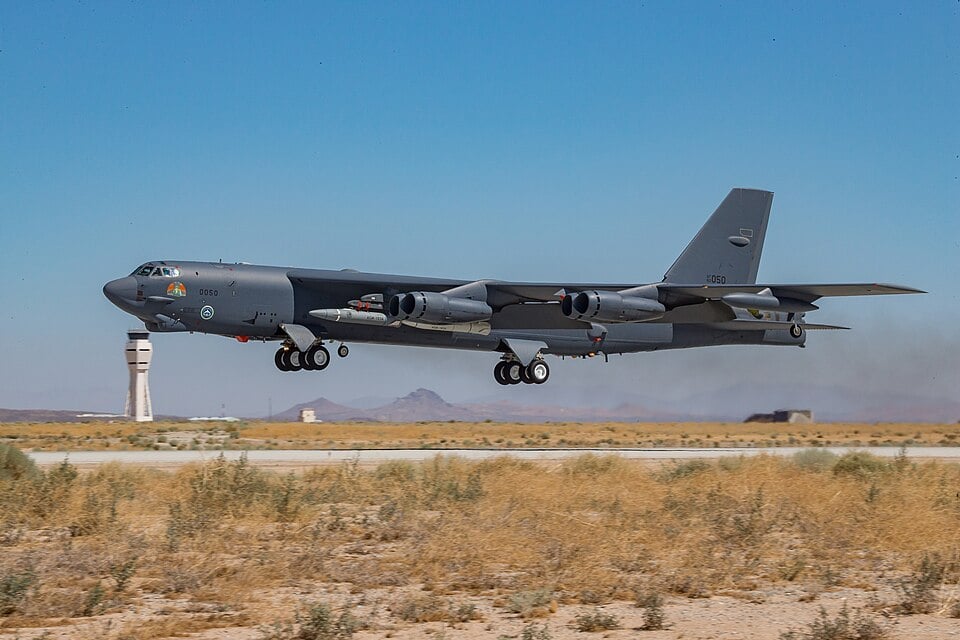
ARRW is a multistage boost-glide weapon in which a rocket booster accelerates the weapon, then separates and leaves a maneuvering glide vehicle to fly on to the target. The Aviationist says the booster is a solid-rocket motor that carries the weapon to the upper atmosphere. The glide vehicle draws on technology from the Tactical Boost Glide (TBG) demonstration.
Air & Space Forces Magazine puts ARRW's speed at five times the speed of sound or greater, "at least 3,800 miles per hour." Another report gives a higher top speed, and the two accounts are not reconciled. Treat the 3,800 mph figure as the published floor.
The Aviationist reports that ARRW carries no conventional explosive warhead and relies on kinetic energy alone to destroy most targets. Budget documents describe ARRW as a standoff weapon and "a lethal capability against high-value time-sensitive targets." None of the sources publishes ARRW's range, length, weight or guidance system.
The B-52 is the initial carriage aircraft, according to Air & Space Forces Magazine, which adds that the B-1 has reportedly been tested and gives no further detail. The Aviationist says the contract confirms ARRW could be fielded on the B-52H Stratofortress and the B-1B Lancer. No source names a fighter or any other aircraft as a carrier.
How the ARRW Missile Went From Cancelled to Contracted
ARRW moved from a 2018 design contract through three launch failures and a 2023 decision not to buy, before a 2025 reversal and the September 2026 production award. The table pulls the dates from Air & Space Forces Magazine and The Aviationist. Where the two give different months for the same event, the table uses the broader period.
| Date | Event |
|---|---|
| 2018 | Development begins. Lockheed Martin signs a design contract worth up to $480 million, building on the X-51, with a prototype capability sought by 2021 |
| 2019 | Captive carry tests take place, and Lockheed Martin receives a $988.8 million contract modification for critical design review |
| 2021 | Congress strips funds for 12 ARRW missiles from the fiscal 2022 plan |
| April 2021 | First launch test fails. Two more failures follow |
| May 2022 | First successful test |
| December 2022 | Test-range sensor failures leave terminal characterization data incomplete |
| March 2023 | Test in which the shroud does not eject |
| Spring 2023 | Air Force acquisition executive Andrew Hunter says the program will end without purchases. The Air Force zeroes out ARRW funds |
| August 2023 | Test in which preliminary data indicate nominal conditions were achieved |
| March 2024 | Live launch from the Reagan Test Site in the Pacific |
| 2025 | Then-Chief of Staff Gen. David Allvin tells Congress the Air Force will buy ARRW |
| Fiscal 2026 | $362 million allotted for ARRW |
| 29 September 2026 | $694 million production contract awarded to Lockheed Martin |
Why the Air Force Walked Away in 2023
The Air Force decided in spring 2023 to end ARRW without buying any missiles and to focus on other hypersonic programs. Leaders said they would concentrate on the smaller Hypersonic Attack Cruise Missile (HACM) and other reusable hypersonic systems. The Aviationist adds that the fiscal 2025 budget request omitted ARRW.
Congress had already cut ARRW once, removing funds for 12 missiles from the fiscal 2022 plan in 2021. The sources do not give Congress's reasons for that cut. They also do not explain what changed between the 2023 decision and Gen. Allvin's 2025 statement that the Air Force would buy ARRW.
Testing continued after the decision not to buy, with the August 2023 and March 2024 launches recorded by The Aviationist. Fiscal 2026 then carried $362 million for ARRW. The 29 September 2026 award followed those steps.
What the ARRW Test Record Does and Does Not Show
The published test record shows three early failures and a first success in May 2022. A 2024 Pentagon assessment found preliminary signs of lethality but not enough data for a full verdict. The 2024 Director, Operational Test and Evaluation (DOT&E) report said the weapon showed preliminary indications it could become operationally lethal. DOT&E said limited test data meant a full assessment was not yet possible.
The same DOT&E report flagged a risk that the few remaining tests might not demonstrate lethal effects against required targets. The Aviationist's list of tests shows mixed results across 2022 and 2023, including a sensor failure and a shroud that did not eject. The March 2024 Reagan Test Site launch is the latest test in the sources.
The two main accounts differ on some dates, including the month of the 2023 decision not to buy, and neither source reconciles them. No source reports a flight test after March 2024. A published result from a later test would add to the March 2024 launch as the latest data point.
The Funding Picture for FY2027 and Beyond
The Air Force has requested $452 million for ARRW production in fiscal year 2027 (FY2027), but that budget is stalled in Congress. The Pentagon is operating under a continuing resolution based on 2026 funding levels. The fiscal 2026 ARRW line was $362 million, so the request is $90 million more ($452 million minus $362 million).
The Future Years Defense Plan projects ARRW procurement of $556 million to $621 million per year from 2028 to 2031. Over those four years, that range works out to $2,224 million at the low end (4 times $556 million) and $2,484 million at the high end (4 times $621 million). These are projections in the Future Years Defense Plan.
The sources also differ on the FY2027 request for ARRW Increment 2 development, so no single figure applies. For how a funding line moves from request to appropriation, and what a continuing resolution holds back, see the US defense budget guide.
What the Air Force Is Not Saying About ARRW
The Air Force has disclosed the contract value and the award date, and the published reports leave quantity, cost per missile and schedule blank. The table lists each open question against what the three sources say.
| Question | What the sources say |
|---|---|
| How many missiles were ordered | Withheld. Quantities are controlled unclassified information |
| Unit cost per missile | Not published in any source |
| Delivery schedule or first fielding date | Not stated |
| Range, length, weight or guidance | Not published |
| Top speed | At least 3,800 mph per Air & Space Forces Magazine. Another report gives a higher figure |
| FY2027 Increment 2 development request | Sources give different figures and do not reconcile them |
What the Contract Means for Lockheed Martin Watchers
The $694 million award is the only published dollar value tied to ARRW production, and it is the one figure a reader tracking Lockheed Martin can use. With no quantity and no delivery schedule, the sources give no basis for a cost per missile or for when deliveries start. No revenue effect for Lockheed Martin can be computed from the published reports.
The earlier ARRW contracts were for design and development: a design contract worth up to $480 million in 2018 and a $988.8 million modification in 2019. Aviation Week says the 2026 award relaunches production of the AGM-183A. The Aviationist attributes it to the Department of War's Enterprise-Wide Agile Acquisition Contract framework.
For another Lockheed Martin program covered on this site, see the Lockheed Martin Vectis profile. The Pentagon's Replicator initiative is a separate autonomous-systems effort with no stated tie to ARRW.
Open Questions on ARRW Quantity, Cost and Schedule
ARRW is now a funded production start. The $694 million contract value is the only published contract value. Air & Space Forces Magazine, The Aviationist and Aviation Week publish no missile count, unit cost or delivery date. The FY2027 production request of $452 million is stalled while the Pentagon runs on a continuing resolution.
A reader who wants a missile count, a range figure or a side-by-side capability comparison with other weapons will not find one in these public sources. That reader should treat any such figure seen elsewhere as unsupported by the published reporting. The contract value, the award date and the funding requests are the facts the sources stand behind.
Three developments would change the picture. Congress could fund the $452 million in FY2027 appropriations. The Air Force could release a quantity or delivery schedule. A new ARRW flight test result could appear. To follow the funding, check the FY2027 status in the US defense budget guide. The original Air & Space Forces Magazine report covers the ARRW missile award.
Guides FAQs
What is the ARRW missile?
The ARRW missile is the AGM-183A Air-Launched Rapid Response Weapon, a hypersonic boost-glide weapon built by Lockheed Martin. A rocket booster accelerates it, then separates and leaves a maneuvering glide vehicle that flies at five times the speed of sound or greater, according to Air & Space Forces Magazine.
How much is the ARRW production contract worth?
The ARRW production contract is worth $694 million. The Air Force awarded it to Lockheed Martin on 29 September 2026 and announced it on 26 October 2026, as reported by Air & Space Forces Magazine.
How many ARRW missiles is the Air Force buying?
The Air Force has not said how many ARRW missiles it is buying. It withheld the quantity for operational security reasons, treating it as controlled unclassified information. No source publishes a unit cost or delivery schedule either.
Which aircraft can carry ARRW?
The B-52 is ARRW's initial carriage aircraft. Air & Space Forces Magazine says the B-1 has reportedly been tested, and The Aviationist says the contract confirms ARRW could be fielded on the B-52H Stratofortress and the B-1B Lancer.
Why was ARRW nearly cancelled?
The Air Force decided in spring 2023 to end ARRW without purchases and focus on the smaller Hypersonic Attack Cruise Missile and other reusable hypersonic systems. That decision followed three failed launch tests starting in April 2021 and mixed results in later tests. The sources do not state a single cause. In 2025, then-Chief of Staff Gen. David Allvin told Congress the Air Force would buy ARRW.
Who builds the AGM-183A ARRW?
Lockheed Martin builds the AGM-183A ARRW. Lockheed Martin has held ARRW contracts since a 2018 design award worth up to $480 million, and it received the $694 million production contract in September 2026.
Is ARRW the same as the Hypersonic Attack Cruise Missile?
No. The sources describe the Hypersonic Attack Cruise Missile (HACM) as a smaller, separate program. In 2023, Air Force leaders said they would focus on HACM and other reusable hypersonic systems when they decided not to buy ARRW.